

From the Ecosystem – You already do this for engineering. Why not for your buyers?
This text is written by Elina Chung, a founder of Elina Chung Oy and a member of Crazy Town Jyväskylä and the EriCa ecosystem.
A decision made on taste
A few years ago I watched a product decision get made because someone liked the way Instagram looked.
Someone senior wanted it to feel more like a consumer app. He would point at the Instagram logo as the model for ours. It was a B2B tool for documenting processes and organising how teams structured their work. At the time, nobody had settled who the ideal customer was, or fully agreed on what the product was for.
Wanting a well-designed product is reasonable. What stood out was the reasoning behind the specific choices: not what would help a customer use the thing, but personal taste. Decisions got made on preference, not on what the product could do, or what it was worth to the people meant to buy it. The question of who it was for had been left open. The strongest opinion in the room filled it.
The company was a scale-up, still testing the market, and it later went through a significant round of layoffs.
What was missing wasn't design sense. It was anyone asking what we actually knew. The influence was real, and it had been earned somewhere: in starting the company, in putting money behind it. But it was being spent somewhere it hadn't been earned, on what an undefined buyer would want from a product we hadn't finished defining.
What engineering already does
Engineering teams have a process for exactly this. After an outage or a failed experiment, a blameless postmortem asks what was known at the time versus what was assumed, and nobody asks whose fault it was. Plenty of companies run that process for engineering. I have never seen one run it for a lost deal, a launch nobody noticed, or a market they entered and quietly backed out of.
I have seen the other version too. At a company I joined later, the ad and agency spend was substantial, but leads either weren't coming in, or the ones that did weren't worth much. The agency's answer was to spend more. Nobody was asking whether the leads were any good.
We stopped spending. Before touching anything else, we worked out who we were selling to, and found three groups sitting under one label, "IT decision makers".
The person evaluating it was reviewing it on technical merit. The people who would use it every day were asking something narrower: does this fit the way I already work, and how does it sit alongside the stack I already have. They rarely thought about how it would benefit the business. The person signing it off understood the product too, but valued it differently again, on what it did for the organisation's governance and risk position, and ultimately the bottom line.
Same product, three different questions, and we had been sending all of them the same words.
We split the messaging to speak to the evaluator and the person signing it off, and deliberately left the users out. In firms that size they weren't making the decision. They were stakeholders in it, and part of the feedback loop once the product was in, which is a different job needing different words. Deciding who not to talk to is part of the same exercise.
With that settled, we worked directly with the agency on the copy. Qualified lead volume improved by roughly 30% over the first year. Not a dramatic number, but a real one.
The three questions
Every time I have done this, it has come down to the same three. Who are we really selling to. What are we selling them. Where are those people looking. Answer those honestly and most of the operational decisions, the channels, the budget, the agency, follow from them. Get them wrong and nothing downstream rescues it.
The honest part is the difficult part. The teams I've asked can answer all three quickly. That speed is the problem, because the quick answer is usually the assumption rather than the knowledge. A useful review separates the two: what did we know, and how did we know it, against what did we believe because nobody had questioned it. Then one follow-up for each belief. What would we have to see to know this is wrong?
None of this needs to be a project. An hour with whoever was in the room, no names, no fault, one page of notes. The output isn't a document. It's one assumption you have agreed to test before the next decision.
A version, not a conclusion
One more, and this one ends better than it starts. A company with a premium product and a strong position at home expanded into a new region, using largely the playbook that had worked there, slightly reframed. Positioning and messaging had never been worked out for the new market specifically. Locally, the sales team was under constant pressure to discount and undercut competitors, because the commission structure rewarded the number of deals closed, not the value of each one. Over time that wore down the premium positioning, and marketing's return fell to almost nothing.
Nobody set out to damage the brand. The incentive structure rewarded one thing, volume, while the actual goal, healthy and valuable deals, was never built into how success was measured.
You could hear it in how people described their own work. When sales raised the quality of the leads, one marketer's answer was that their job was to bring in volume, not to qualify it. It landed as arrogance. It was also an accurate description of the role as it had been defined. Volume was what the work was measured on, so volume was what the work produced. That’s what an incentive problem sounds like from the inside: no decision anyone can point to, just people doing the job they were given.
The correction was expensive, and it was quick. Half the marketing team went, along with some of sales. It's worth noticing where the cut landed. The function that couldn't show a return was the one that shrank. I was in it.
Then the direction changed. The discounting stopped. The money that had gone into undercutting competitors went into building credibility with voices the industry already trusted, to build the standing it had assumed it already had. The company repositioned itself and carried on. Getting it wrong wasn't fatal. Not noticing could have been.
Some companies never do any of this and survive anyway. If you sell something inexpensive to a very large number of buyers, you can afford to guess repeatedly and let volume find the answer for you. Unfortunately that isn't available to you if the sales cycle is long, the pilots are expensive and the number of possible buyers is smaller. Then you get a limited number of attempts. Decide beforehand what each one is meant to test, or it will teach you the wrong thing as easily as the right one.
The one question worth adding
Treat your view of the market the way you already treat your product: as a version, not a conclusion. A product still finding its buyers is in beta. So is everything you believe about those buyers, including the price you put in front of them. A price set for a market you haven't entered yet is an informed estimate, not a fact: you make the best call you can, then test it and adjust quickly when the evidence says otherwise.
Three companies, the same root cause each time: a belief about the market treated as settled fact instead of something to check. The method isn't complicated, and it isn't new to you. Pause, ask what was known, review without blame, adjust. You already run it on the technical side of the business. The harder question is what stops it reaching the room where decisions about buyers, positioning and price get made.
Next time something you were sure about turns out to be wrong, the useful question isn't whose fault it was. It's whether you knew, or you assumed.
Elina Chung
Elina Chung Oy
 Elina Chung runs Elina Chung Oy. She works on international B2B market strategy: who you sell to, what you sell them, and why it lands. Twelve years in-house in B2B technology, including SaaS, cybersecurity and health technology, in Australia, Asia-Pacific and EMEA. She mentors on EriCa Reactor.
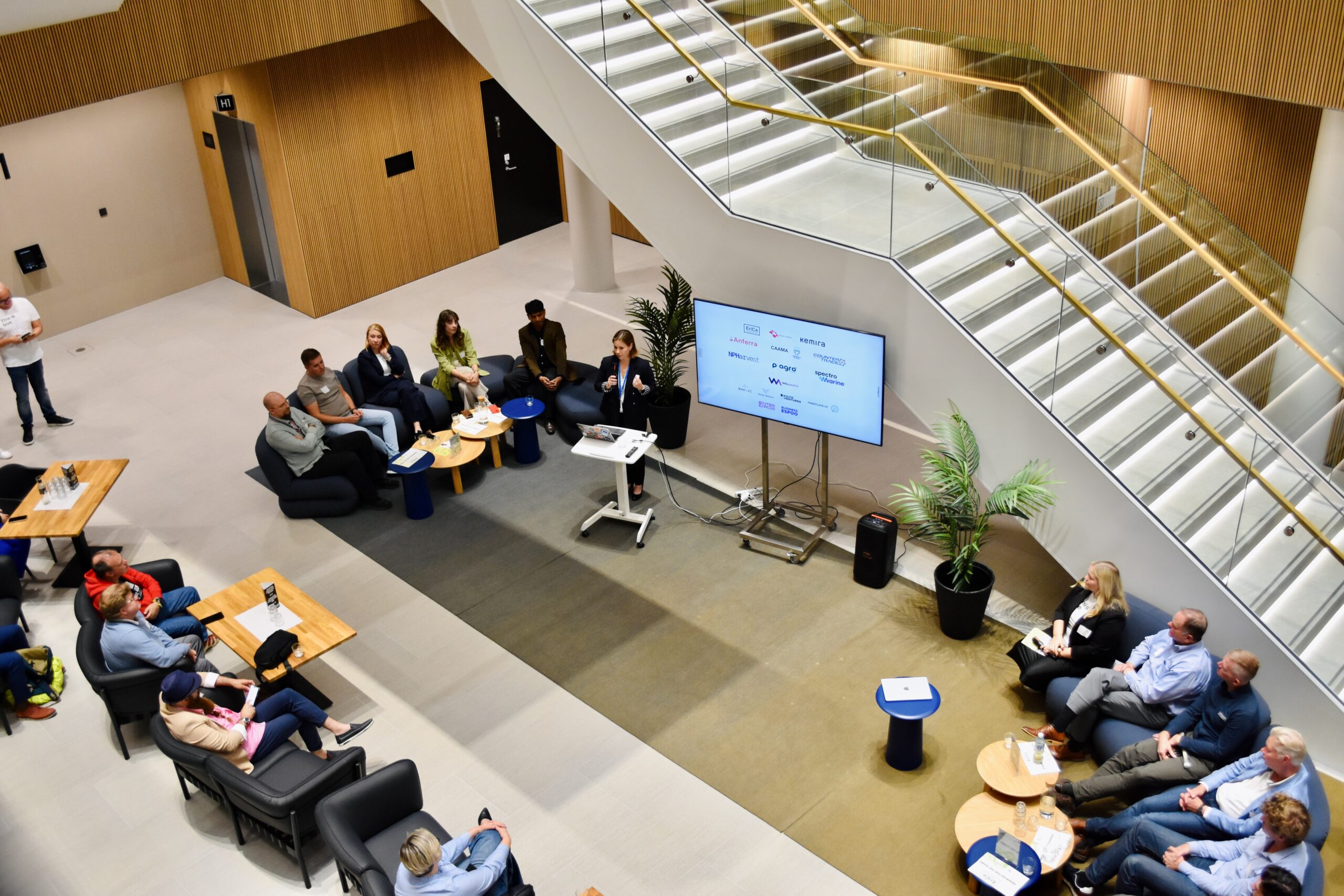
First Results from EriCa Reactor: Funding, Pilots and Continued Collaboration
What can happen in five months when deep tech teams work directly with industry experts, investors and other startups?
The first EriCa Reactor cohort gives some early answers: more concrete pilot plans, clearer market focus, stronger business models, new investor and industry connections, funding, and continued collaboration beyond the program.
EriCa Reactor is an accelerator operated by Crazy Town at EriCa Green Chemistry Park. Kemira, a global leader in sustainable chemistry for water-intensive industries, serves as the lead industry partner for the first two cohorts.
The first cohort ran from March to August 2026 and brought together seven startups and research-based teams developing clean water solutions from five countries:
- Anferra, Sweden
- CAAMA / University of Oulu, Finland
- Countertrace, USA
- NPHarvest, Finland
- P-Agro Minerals, Latvia
- Spectromarine, the Netherlands
- Wellmatix, South Korea
The aim was to help the teams move from lab to market — towards industrial validation, pilots, customers and commercialization.
During the five-month program, teams received 1:1 coaching from Kemira experts, peer support, facilitated workshops, investor introductions and access to the EriCa ecosystem.
The first results suggest that the value was not only in individual meetings or workshops. For many teams, the collaboration changed what they decided to focus on next.

From pilot ideas to concrete validation plans
For several teams, one of the main goals was to prepare for industrial-scale testing and piloting.
Working with industry experts helped turn high-level pilot ideas into more concrete validation plans. Teams received support in defining what data industrial partners would need, which KPIs and technical specifications should be monitored, how results should be analyzed, and what would need to be demonstrated before moving forward.
For some teams, this resulted in detailed pilot or prototype validation methodologies. It also helped clarify the right sequence of commercialization activities: whether the next priority should be sales, technical scaling, validation or collecting further data for future customer discussions.
That kind of clarity can be highly valuable in deep tech development. It helps teams understand not only what to do next, but also what may still be too early to pursue.
Sharper market focus and stronger business models
Technology development is only one part of commercialization. Teams also need to understand where their technology creates the most value and which applications are worth pursuing first.
During the program, teams worked on their market position, value proposition, customer needs and priority applications. For some participants, this meant narrowing down a broad set of potential use cases and focusing on the ones with the clearest customer need and commercial potential.
The collaboration also supported business model development.
For one team, discussions during the program contributed to a pivot towards a new business model. This raised practical questions around customer agreements, responsibilities, risk sharing and how to structure an arrangement that works commercially for both parties.
Industry experience provided useful insight into these questions and into what should be considered when negotiating with customers. The goal was not simply to refine a business model on paper, but to develop an approach that could work in real industrial customer relationships.
Access to expertise, industry and investors
For early-stage deep tech companies, access can be as important as advice.
Several teams highlighted that the program helped them build connections and enter conversations that would otherwise have been difficult to access independently.
Investor introductions opened doors to new discussions, while interaction with Kemira gave teams access to technical and industry expertise in areas such as water treatment, chemistry, industrial applications and piloting.
The value was not simply in introducing startups to a large company. The program created a setting where both sides could explore technologies, applications and commercial opportunities in sufficient detail to identify whether there was potential for further collaboration.
At the same time, Kemira was able to explore how its own chemistry and technical expertise could complement the technologies and innovative products developed by the participating teams.
Funding, new capabilities and continued collaboration
The program also contributed to tangible company-level outcomes.
During the first cohort:
- teams secured combined over 2 M€ of financial investments and funding for further piloting and development
- concrete plans for continued development collaboration with Kemira and other industry partners progressed
- a team recruited a new person to lead commercialization
- an international company established a Finnish entity and gained a home base at EriCa
- teams gained new investor, industry and ecosystem connections
 The industry partner learns too
EriCa Reactor is not designed as a one-directional coaching program. The idea is that startups and industry work together, and both sides learn.
For Kemira, the first cohort provided insight into the entrepreneurial mindset and working methods of early-stage technology companies, including agile ways of working, strong focus and energetic and proactive approach to tackle challenges. Kemira gained insights on how startups prioritize activities, engage investors, rapidly test business concepts, and adapt to customer requirements under resource and time constraints.
The collaboration also created opportunities to evaluate how Kemira’s existing chemistries, technical expertise and capabilities could be combined with emerging startup technologies in different water treatment related applications.
The five-month program resulted in concrete plans for continued development collaboration and Kemira sees lots of potential for future projects. More about these collaborations will be shared as the time is right.
What did we learn?
The first EriCa Reactor reinforced the idea the program was built around: Deep tech commercialization does not happen in isolation.
A strong technology is not enough. Teams need real use cases, customer understanding, industrial expertise, technical validation, industrial piloting, funding and access to organizations that can help them take the next step.
For the first EriCa Reactor cohort, the program’s end was therefore not the end of the process. It was one milestone in a longer journey that continues through pilots, development projects, investment discussions and new partnerships.
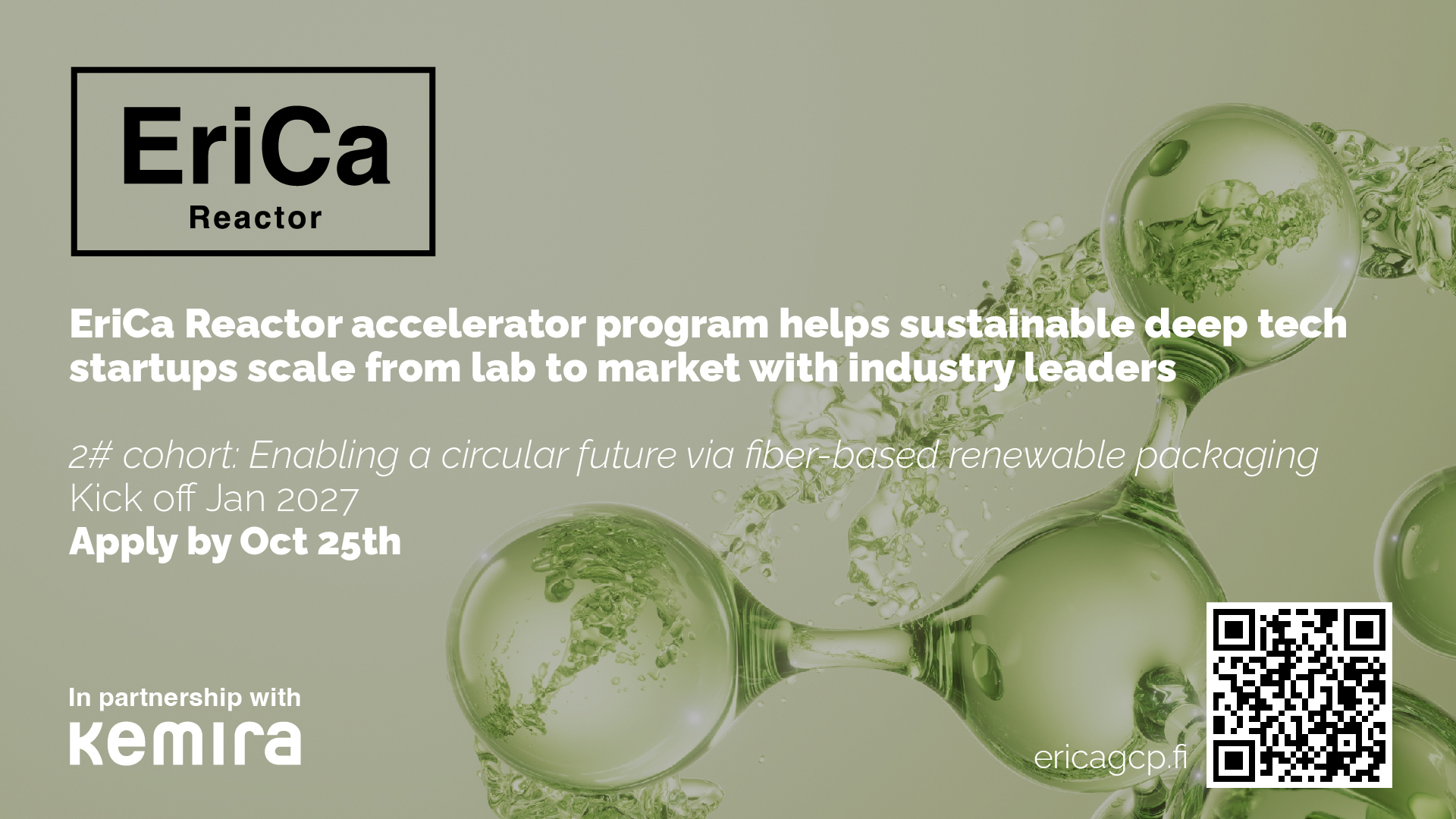 Next: renewable fiber-based packaging
EriCa Reactor is now preparing for its second cohort together with Kemira under the theme:
“Enabling the Future of Circularity with Renewable Fiber-Based Packaging.”
The program is looking globally for 6–8 startups, scaleups and research-based spinoffs developing innovative solutions related to packaging and the fiber industry.
Applications are open until 25 October 2026.
Learn more and apply: https://ericagcp.fi/reactor
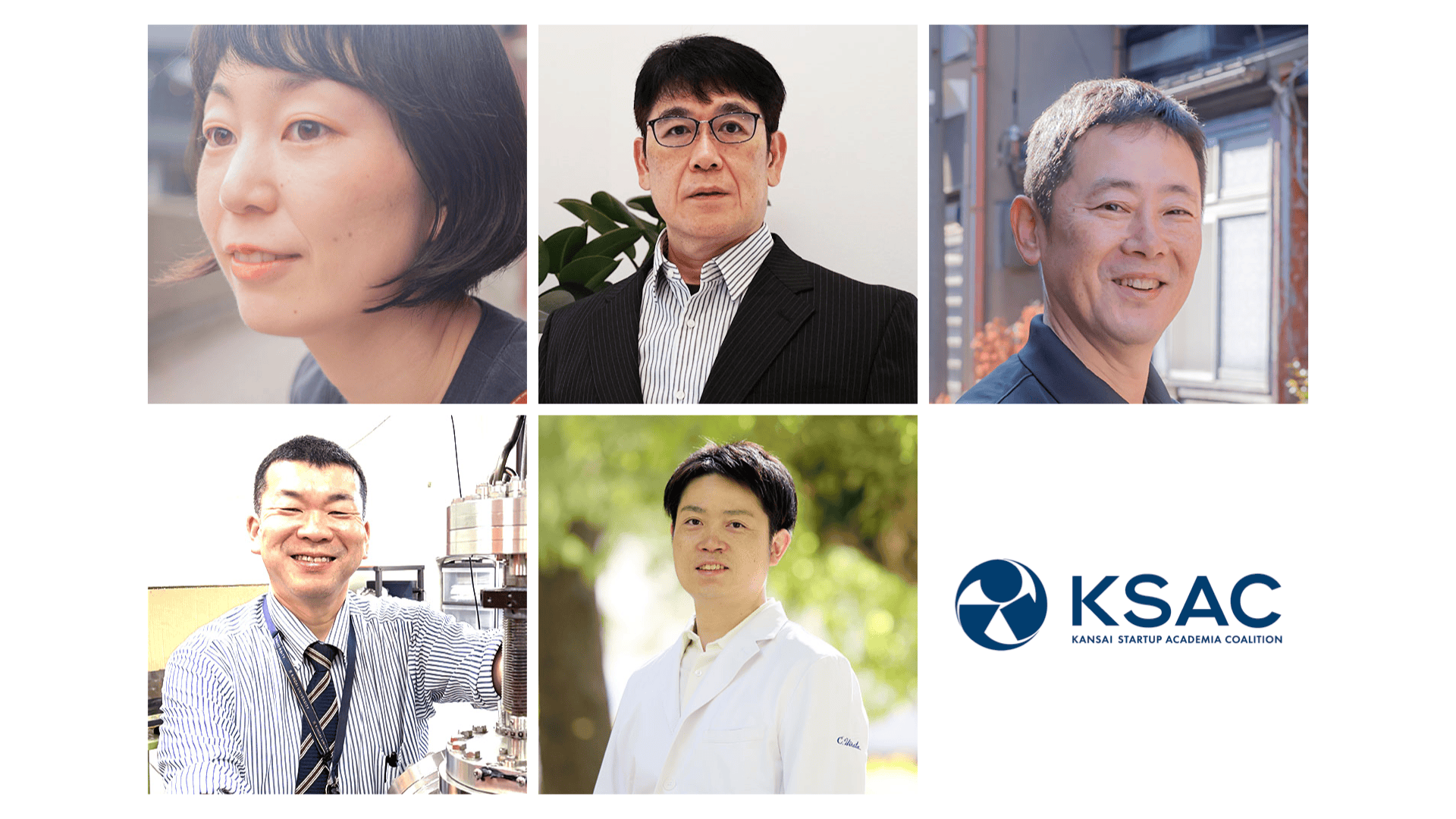
Five Japanese researchers seek Finnish partners to bring innovations from lab to market
Scientific research can help address global challenges. Turning discoveries into useful products and services takes business expertise, testing and partners. This October, five Japanese researchers will visit Finland to explore how Finnish expertise could help move their work forward.
The KSAC Finland Program brings the researchers to Espoo and Helsinki on 19-23 October 2026. Selected through an application process, they are exploring commercial opportunities for research in water reuse, biodegradable materials, wearable sensors and new treatments.
Finland’s connections between universities, research organisations and companies provide a setting for this work. The programme introduces participants to Finnish partners and helps them assess different routes to market, from starting a company to licensing technology or working with an established business. For Finnish organisations, the visit is an opportunity to find research that could support their own development work and build connections with universities and innovation organisations in Japan.
Crazy Town, the operator of EriCa Green Chemistry Park, is involved as the Finnish coordinator for the program and will also bring the researchers to EriCa.
From research to practical use
The five projects address different problems, but each faces a common question: what will it take for the research to become useful outside the laboratory?
The participants are at different stages of answering that question. Some are exploring possible applications and business models, while others are further along in developing their plans. During the visit, they will meet Finnish experts to discuss market needs, development challenges and possible next steps.
Finnish companies can contribute knowledge of customers, market needs or industrial requirements. Researchers can identify opportunities for joint work and testing. Investors and business development experts can help clarify what evidence and capabilities a project needs before it is ready for investment.
These discussions could lead to joint research, preparation for a pilot or a clearer understanding of where a technology has commercial potential. The programme aims to help participants identify a useful next step and the people who could help them take it.
The five researchers and their work
Haruka Takeuchi — Kyoto University
Takeuchi is developing decentralised water treatment and reuse systems. The aim is to allow water to be treated and reused locally, supporting more sustainable water use.
Shu Ishikawa — Kobe University
Ishikawa is developing uLtra-PGA, a biodegradable polymer produced by fermentation. The initial focus is on cosmetic ingredients, with potential for later use in medical and industrial applications.
Motoshi Sobue — Nara Institute of Science and Technology, NAIST
Sobue is developing a treatment approach aiming for lasting therapeutic effects in conditions such as Parkinson’s disease and drug addiction. The underlying technology also has potential for more immediate applications in other areas.
Hiroaki Nishikawa — Kindai University
Nishikawa is developing thin ceramic films that retain their functional properties while bending. These materials could be used in wearable sensors that monitor signals from the body.
Chuji Hirota — Osaka Medical and Pharmaceutical University
Hirota is part of a team developing a scaffold to support the regeneration of joint cartilage. The approach aims to enable repair in a single procedure without donor tissue.
Read more about the researchers and their projects here.
Building connections that last beyond the visit
The Finnish programme is coordinated and facilitated by Crazy Town, together with Enter Espoo, VTT, Aalto University and other partners, including Helsinki Partners.
Commercialising research also takes trust between people. The programme helps researchers build this social capital through meetings, shared learning and informal conversations. Getting to know each other makes it easier to discuss uncertainties, ask for help and continue working together after the visit.
During Espoo Innovation Deep Dive on 19–22 October, Enter Espoo introduces relevant local organisations and networks. VTT shares its experience in research commercialisation, while Crazy Town helps participants learn from each other, meet potential partners and identify next steps. Aalto Startup Center welcomes the researchers to 100STARTUPS on 21–22 October, where they can meet founders and other participants.
Helsinki Partners supports KSAC in hosting a pitching event 23 October, where the researchers will present their work and meet potential collaborators through one-to-one meetings and networking.
Meet the researchers in October
Finnish companies, researchers, investors and organisations supporting research commercialisation are invited to meet the participants.
To explore a meeting during the visit, contact the Crazy Town programme team at projects@crazytown.fi
Tell us which project interests you and what you would like to discuss. Suggestions for relevant contacts are also welcome.
Two open events offer an opportunity to meet the researchers and learn more about their work:
20 October, 16:00–18:30, Espoo | Japan–Finland deep tech afterwork
An informal gathering at EriCa with the researchers, KSAC representatives and Finnish participants. Join to exchange ideas and discuss opportunities for cooperation. Details and registration >>
23 October, 10:00–15:00, Helsinki | Japanese Researchers’ Pitch & Meet-up
KSAC and Helsinki Partners host a day of researcher presentations, networking and individual meetings. Programme and registration >>
About KSAC
Kansai Startup Academia Coalition (KSAC) supports entrepreneurship and university-based startups in Japan’s Kansai region. It brings together universities, companies, financial organisations and local governments to help research reach practical use and international markets.
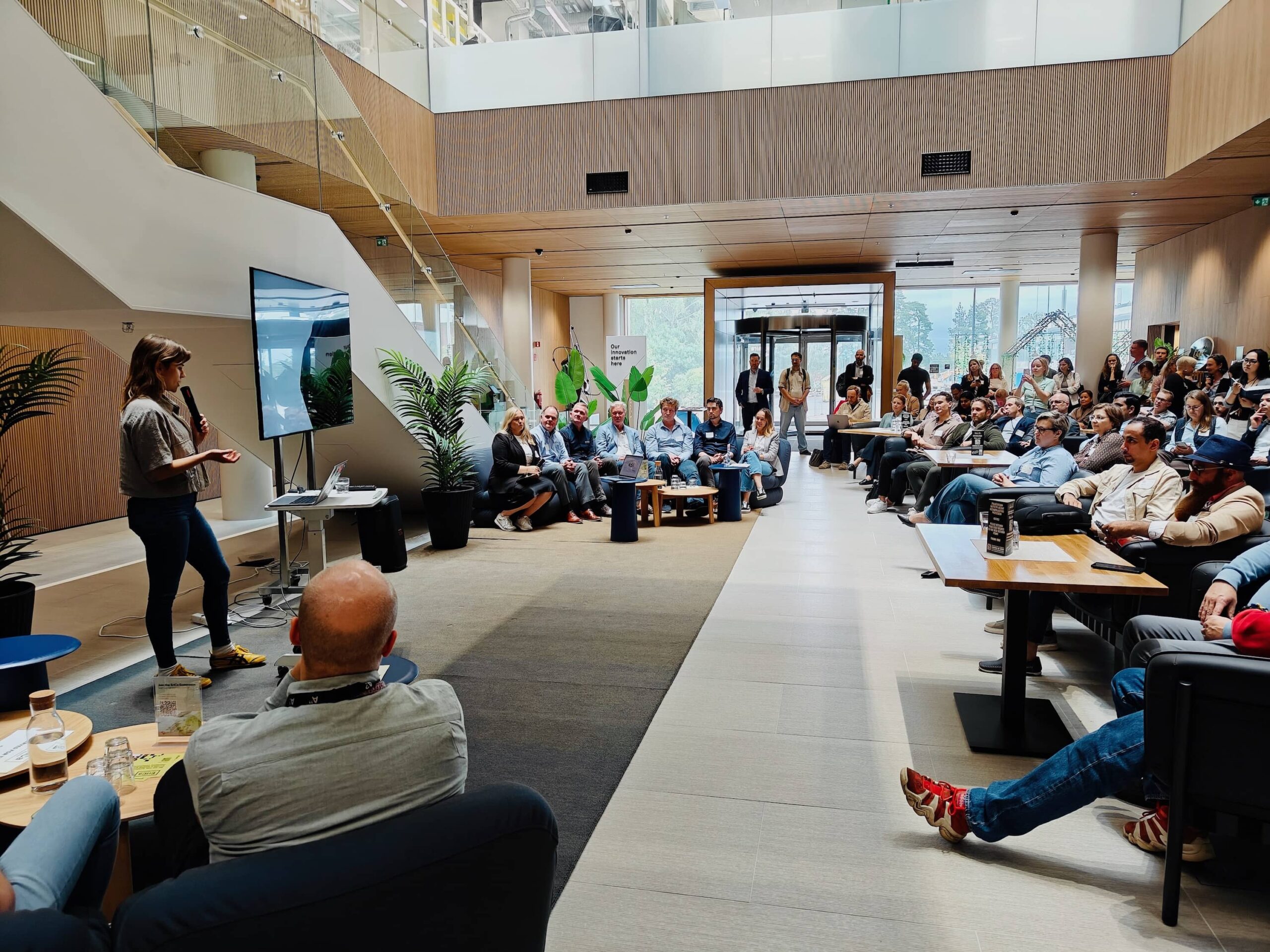
Seven approaches to clean water: First EriCa Reactor cohort moves towards the market
According to WHO and UNICEF, 2.1 billion people globally lack access to safely managed drinking water. Kemira’s solutions already help enable clean water for around 400 million people worldwide. Both figures show the scale of the challenge – and why no single company or technology can solve it alone.
That is why clean water was selected as the theme for the first EriCa Reactor cohort.
On 20 August, 2026 the sold-out EriCa Reactor Demo Day brought close to 100 people from industry, investors, startups, research and the wider innovation ecosystem to EriCa Green Chemistry Park in Espoo.
Seven teams from five countries took the stage to share what they had learned, where their solutions are heading and what kind of customers, pilot partners, investors and collaborators they are looking for next.
Different technologies for different parts of the water challenge
The cohort demonstrated how broad the clean water challenge is. Improving water quality is not only about purification. It also involves monitoring water in real time, recovering valuable materials, reducing waste and chemical use, improving industrial processes and developing new materials.
The seven teams approach these questions from different directions:
- Anferra uses circular chemistry to turn iron-rich industrial residues into useful water-treatment chemicals and other recoverable materials.
- CAAMA / University of Oulu develops a reusable adsorbent-based process that removes metals from industrial water and enables their recovery as valuable resources.
- Countertrace develops programmable polymer pellets designed to selectively capture targeted substances from water and release them for recovery or safe handling.
- NPHarvest recovers nitrogen and phosphorus from nutrient-rich wastewater and converts them into fertilizer products.
- P-Agro Minerals develops a filtration system that removes phosphorus from wastewater and enables it to be reused as a soil amendment.
- Spectromarine combines underwater optical sensing and analytics to give industrial water operators continuous insight into water quality and biofouling.
- Wellmatix uses AI to guide the discovery and optimization of advanced materials for water-treatment challenges such as contaminant removal and sludge dewatering.
Together, these approaches span chemistry, materials science, resource recovery, sensing, data and artificial intelligence. They also show why solving the water challenge requires collaboration between different technologies, industries and areas of expertise.

Five months of moving closer to the market
EriCa Reactor helps sustainable deep tech scale from lab to market with industry. Implemented by Crazy Town in partnership with Kemira, the program combines startup agility with industrial R&D expertise, market insight and global reach.
During the five-month program, the teams worked with Kemira experts and coaches, as well as partners and investors from the ecosystem to identify opportunities, validate use cases and understand what would be required to move their technologies forward.
The work focused on customer and industry needs, commercial focus, pilot preparation, industrial testing, investor readiness and finding the right partners for the next stage.
The results look different for every team, as they should. Across the cohort, teams:
- refined their business cases and commercial focus based on industry feedback
- prepared pilot plans and pathways towards industrial validation
- advanced commercial and collaboration discussions
- strengthened their investor readiness and built new funding connections
- connected with potential customers, partners and ecosystems in Finland and elsewhere in Europe
- moved research-based cases closer to company formation and strengthened their teams
- built close working relationships with industry mentors and experts
Some commercial discussions and pilot preparations are still ongoing and cannot yet be shared publicly. We will tell more about the teams and their individual progress later.
One public example is Wellmatix from South Korea. With support from the program, the company completed its soft landing in Finland and established Wellmatix Oy in summer of 2026. The team now has its Finnish home base at EriCa and is building relationships with customers and partners in Finland.
Demo Day was a meeting point, not only a stage
Demo Day gave the teams an opportunity to present their progress, but the stage was only one part of the afternoon. The conversations continued during networking and the informal afterwork, bringing the teams together with Kemira experts, investors and potential collaborators.
Deep-tech commercialization rarely advances through a single pitch or meeting. It requires sustained work, trust, technical understanding and the right people finding reasons to continue together.
This is also what EriCa is designed to provide: physical infrastructure, access to industry and the social capital needed to turn technical progress into commercial progress.
Demo Day was therefore not simply the end of a cohort. For many of the teams, it opened the next phase of pilot preparation, commercial validation, fundraising, company-building and international collaboration.
Thank you to all seven teams, Kemira, our coaches and mentors, investors, ecosystem partners and everyone who joined us at Demo Day, as well as supported the teams.

Next EriCa Reactor call now open
At Demo Day, we also introduced the second EriCa Reactor cohort: Enabling a circular future via fiber-based renewable packaging.
We are looking globally for startups, scaleups and research-based spinoffs developing solutions in renewable packaging, advanced functionality and product properties, recyclability, process efficiency, chemical solutions, digital and AI applications, and new business models.
The program is intended for teams with validated technology at TRL 4 or above that are ready to work with industry and take concrete steps towards pilots, commercialization and international growth.
The five-month program runs from January to May 2027 in a hybrid format, combining activities in Espoo with online sessions. Participation is free of charge and no equity is taken.
Applications are open until 25 October 2026.
Learn more and apply to EriCa Reactor
EriCa Reactor is implemented by Crazy Town in partnership with Kemira.

EriCa Reactor opens global call for fiber-based renewable packaging solutions
Applications are now open for the second round of EriCa Reactor, helping sustainable deep tech scale from lab to market with industry.
Starting in January 2027, the second cohort focuses on enabling a circular future through fiber-based renewable packaging. We’re looking globally for startups, scaleups and university or industry spinoffs developing differentiated technologies and solutions at TRL 4+.
Kemira, a global leader in sustainable chemical solutions for water-intensive industries, continues as the lead industry partner, bringing R&D expertise, industry insight and pathways toward validation, testing and potential pilots.
Global demand for fiber-based packaging continues to grow. At the same time, climate impact, resource scarcity and the need to replace single-use plastics are increasing demand for more sustainable, recyclable and high-performing solutions.
We are looking for innovations in:
- Renewable packaging
- Advanced functionality and product properties
- Recyclability and product performance
- Process efficiency and enabling technologies
- Chemical solutions
- Digital and AI-driven solutions
- New business models
More than an accelerator: From validation to industrial scale
EriCa Reactor is designed for deep tech teams that are already beyond the idea stage and ready to validate, pilot and scale with industry.
Scaling deep tech from lab to industrial use requires more than promising technology. It requires customer understanding, validation, industry connections and access to environments where solutions can be tested and developed.
Selected teams receive five months of free EriCa membership, including access to coworking and project spaces and the EriCa Shared Labs at EriCa Green Chemistry Park in Espoo.
The program helps teams to:
- Validate technologies, applications and use cases with industry
- Understand customer and industry requirements
- Prepare and design pilots and industrial trials
- Use shared laboratory infrastructure for testing and development
- Connect with industry experts, R&D teams, customers and investors
- Build readiness for international growth and industrial scale-up
The EriCa Shared Labs are now operational, providing flexible laboratory infrastructure for startups, spinoffs and project teams working on sustainable deep tech.
“Deep tech companies need customers, industry expertise, validation and access to environments where they can test and scale their solutions. EriCa Reactor brings these elements together to help companies move from lab to market,” says Oona Sulkunen from Crazy Town, the operator of EriCa Green Chemistry Park.
Kemira brings industry insight, R&D expertise and scale
Startups bring agility and fresh ideas. Kemira brings scale, industry insight and R&D expertise. Together, solutions can reach markets faster.
Kemira is the lead industry partner for the first two EriCa Reactor cohorts, and its global innovation center is located onsite at EriCa Green Chemistry Park.
The collaboration gives participating teams access to industry expertise and supports the path toward validation, pilot preparation, industrial testing and potential further collaboration.
Building on the first cohort
The first EriCa Reactor cohort launched in March 2026 around clean water and brought together seven teams from five countries.
During the program, participating teams have already:
- Secured hundreds of thousands of euros in new funding
- Initiated new pilots and industrial testing
- Received support in designing pilots and preparing for scale-up
- Built new R&D and industry collaborations
- Connected with new investors, customers and international partners
Participation has also provided teams with external validation that can strengthen discussions with customers, investors and future partners.
The first cohort demonstrates what EriCa Reactor is designed to do: help promising deep tech move from validation toward pilots, funding and industrial scale.
Who should apply?
We are particularly looking for teams that:
- Offer differentiated, market-shaping solutions in fiber-based packaging and related materials
- Have scalable technologies with initial technical validation and a credible business model (TRL ≥ 4)
- See clear value in collaboration with a global industry partner
- Target international growth and market expansion
- Have a committed and capable team
- Have secured initial funding or other external support
Applications are open to startups and university or industry spinoffs worldwide.
Key dates
- Apply by October 25, 2026
- November 2026: Selection interviews and announcement of selected teams
- December 2026: Team onboarding
- January 11–13, 2027: Program kickoff onsite in Espoo, Finland
- January–May 2027: Workshops, coaching and mentoring; five months of free EriCa membership and access to shared laboratory and workspace infrastructure
- May–June 2027: Demo Day onsite in Espoo, Finland and program offboarding
For more information and to apply, click here.
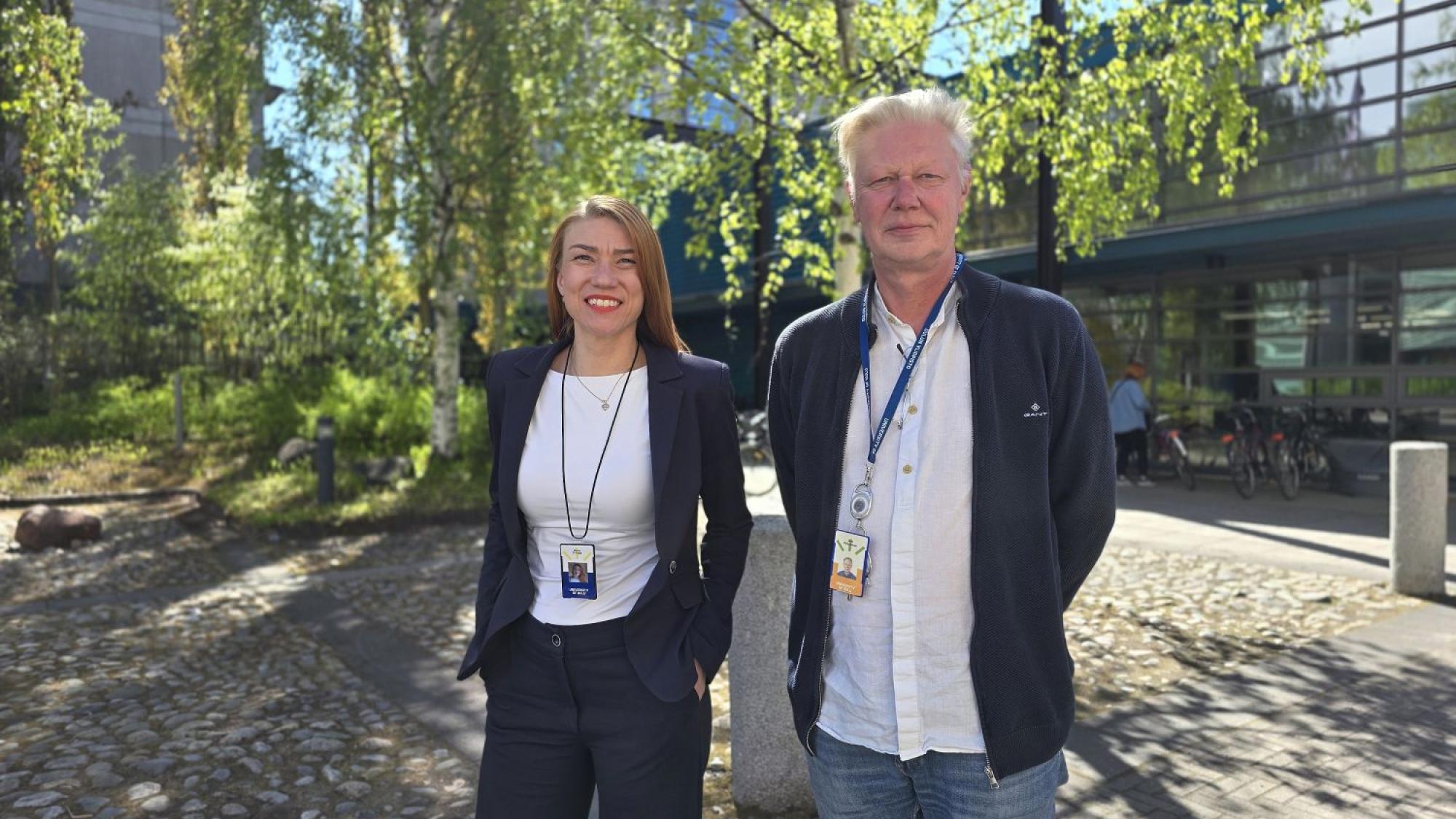
A University of Oulu innovation targets a billion-euro market by helping industry clean water and recover valuable metals
CAAMA (Column-Casted Alkali-Activated Material Adsorbent) is a water purification and metal recovery method developed by chemist and researcher Arto Pikkarainen. Its goal is to make industrial water treatment not only more environmentally friendly but also economically viable. At the core of the technology is a novel adsorbent material made from environmentally safe and natural raw materials. In several tested industrial waters, the method has achieved up to 95–100 % metal removal and recovery efficiency.
“Our goal is to help industry turn water treatment from a cost into value creation. When valuable dissolved metals can be recovered from water, we are not only talking about environmental benefits but also about new business potential”, says Pikkarainen.
Stricter environmental requirements drive demand for new solutions
Environmental regulations are becoming increasingly stringent. At the same time, the green transition is increasing the demand for critical metals. Companies are actively seeking solutions to reduce environmental impact and improve water treatment efficiency.
CAAMA has attracted interest because it simultaneously addresses several key challenges in industry: tightening environmental regulation, growing demand for critical raw materials, and the need for improved resource efficiency. The technology enables water purification and metal recovery within a single process, which can transform wastewater streams from a liability into a valuable resource.
“We have had extensive discussions with mining companies and metal processors. We are now focused on understanding real customer needs, validating the business potential of the solution, and building a path toward market adoption”, says Minna Törmälä, who works on the project as a commercialization expert.
From laboratory to industrial pilots
The technology has been validated with several industrial waters and successfully piloted at a Finnish mine. During the summer of 2026, a new industrial pilot will be carried out to demonstrate the solution’s functionality, reliability, and cost-efficiency in real operating conditions. The pilot unit has been built into a six-metre shipping container, which functions as a mobile water treatment unit.
“The industrial pilot is an important step for us. It provides valuable data on the technology’s performance, customer needs, and helps us build the foundation for future collaboration”, says Pikkarainen.
The pilot unit has been built into a six-metre shipping container, which functions as a mobile water treatment unit.
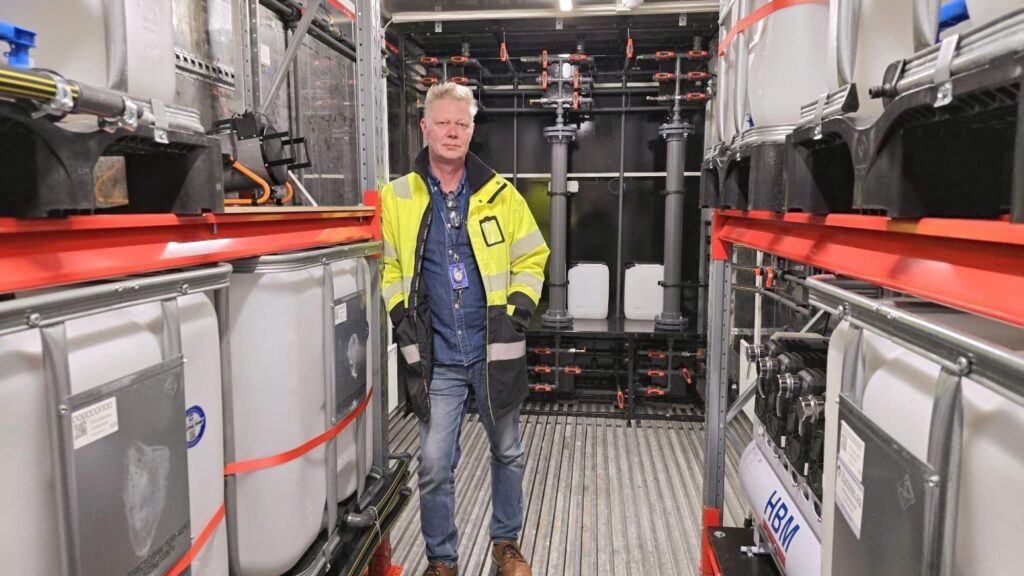
EriCa Reactor accelerator opens doors to international markets and networks
A significant step in the commercialization of the technology was the project’s selection for the EriCa Reactor accelerator programme, whose first cohort focuses on clean water solutions. The programme aims to accelerate the scaling of sustainable innovations from laboratories to markets through collaboration and partnerships. Through the programme, the CAAMA team gains access to international networks, market expertise, investors, and industry experts.
“We are extremely pleased with the selection. Only two projects from Finland were chosen. Strong networks and the right partners are crucial at this stage when the goal is to build a globally scalable business. Through the programme, we have gained many valuable contacts”, Pikkarainen says.
The programme’s main partner is Kemira, which supports participating teams by offering mentoring, coaching, and insights into business growth and success in global markets.
“Kemira is committed to the EriCa Reactor programme because global sustainability challenges – such as climate change, water scarcity, and the responsible use of natural resources – are too complex for any single actor to solve alone. Overcoming these challenges requires new, innovative solutions and close collaboration between different stakeholders”, says Tuomas Mehtiö, who works in new technology and innovation research at Kemira. “The solution developed in the CAAMA project has significant potential in wastewater purification and metal recovery. During the EriCa Reactor programme, the aim is to jointly assess and develop opportunities to scale up pilot activities toward industrial-scale solutions.”
The programme is implemented in practice by Crazy Town. According to Crazy Town expert Toni Pienonen, projects like CAAMA are increasingly needed:
“Too few research results in Finland are translated into practical solutions that improve the world through commercialization. Researchers like Arto, who take steps toward deep tech entrepreneurship, deserve all possible support and encouragement”, he says. “Deep tech teams need commercial expertise early on – business professionals who bring customer understanding and sales capabilities. At Crazy Town, we aim to offer a peer environment, as well as ideas, contacts, support, and inspiration,” Pienonen adds.
New expertise to support commercialization
The project’s commercialization is being accelerated by the addition of Minna Törmälä to the team. She has a strong background in commercializing new technologies, business development, and international marketing. Törmälä also holds a doctoral degree in economics and business administration from the University of Oulu, bringing strong commercial expertise to the team.
Törmälä joined the project with the support of LähiTapiola’s Kasvukipinä funding, which aims to promote the creation of research-based companies.
“There is often a gap between research and business where even promising innovations can stall. This type of support is important to ensure that truly impactful innovations find their way to the market and into use”, Törmälä says.
Pikkarainen also highlights the importance of the Innovation Centre in the project’s development:
“The Innovation Centre’s support in building contacts and securing funding has been extremely valuable, especially at the stage where a gap can easily emerge between research and commercialization.”
Toward an international growth company and value from side streams
The goal is to build a growth company around CAAMA that helps industry respond to increasingly stringent environmental regulations while making more efficient use of industrial side streams. At the same time, the technology supports Europe’s efforts to strengthen self-sufficiency in the availability of critical raw materials and to advance the green transition.
While the first applications are in the mining industry, the technology also has potential in the battery, metal, forest, textile, and chemical industries, where wastewater and process water contain metals in dissolved form.
“Clean water is the world’s most important resource. At the same time, there is a growing shortage of critical metals. We have a solution that can address both challenges simultaneously,” Törmälä says.
“In the future, no water stream containing valuable metals should be viewed simply as waste. We envision a world where industrial waters are treated not only for environmental reasons, but because the materials they contain are too valuable to lose”, Pikkarainen emphasizes.
Interested in collaborating?
The CAAMA team is actively seeking pilot customers, industrial partners, and investors to help accelerate the commercialization of the technology.
If you would like to learn more about the technology or explore collaboration opportunities, please contact:
Minna Törmälä
Business Development & Commercialization Lead, University of Oulu
minna.m.tormala@oulu.fi
+358 50 367 2091
This article is republished from a post originally published on Innoblog by the University of Oulu.
Europe needs fertiliser - NPHarvest makes it from wastewater
As Europe looks for domestic and circular fertiliser sources, Finnish deep tech company and EriCa Reactor participant NPHarvest is turning nutrient-rich liquid waste streams from sources such as biogas plants into valuable fertiliser inputs. The same process can reduce nutrient emissions, lower disposal costs, create new value streams for operators and help make Europe less dependent on imported fertilisers.
Fertiliser is no longer a boring input, it is Europe’s next strategic dependency
Europe learned the hard way that energy dependency is not just an economic issue. It is a political one. It shapes industrial policy, food prices, national security and the ability of countries to act independently.
Fertilisers are now moving into the same category.
Food does not grow without nitrogen and phosphorus. They are basic inputs for agriculture, but Europe remains dependent on imported fertilisers, fossil-based production and fragile global supply chains. Russia’s war in Ukraine made this dependency visible. Iran’s closure of the Strait of Hormuz in March 2026 added another layer of urgency: when global shipping routes can be disrupted overnight, the inputs behind European food production become harder, more expensive and politically riskier to secure.
That sounds obvious, almost too basic to say out loud. But it is exactly the kind of basic dependency Europe tends to ignore until it becomes a crisis.
NPHarvest co-founder Juho Uzkurt Kaljunen and recovery modules of the demo unit
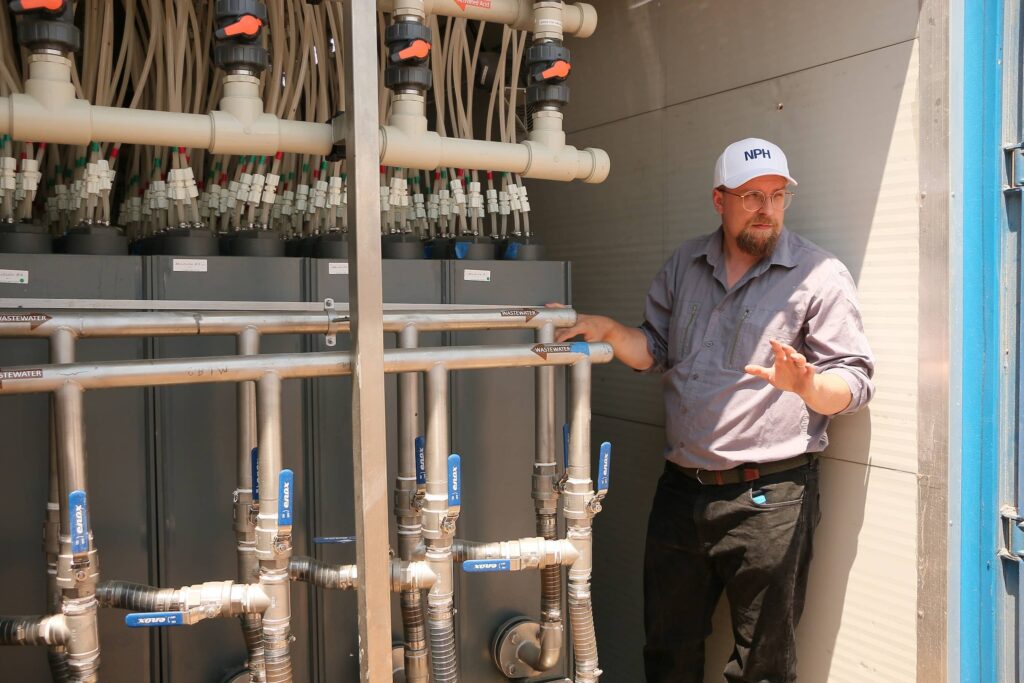
As NPHarvest co-founder Juho Uzkurt Kaljunen said in an article of Tekniikan Maailma: “Nitrogen and phosphorus are as essential as water itself.”
That sentence changes the frame. Fertiliser is not a technical side issue for farmers. It is part of the machinery that keeps modern food production alive.
Without fertilisers, the world could feed only a fraction of its current population. Yet the current system still wastes what it needs most. Phosphorus is mined from the ground. Nitrogen is captured from the air through an energy-intensive industrial process. Nutrients flow through farms, cities and wastewater systems — and then society pays to remove them instead of recovering them.
Around 80 percent of countries are net importers of nutrients. Roughly 30 percent of nutrients end up in wastewater. At the same time, the ammonia value chain represents an estimated €150 billion in annual costs and around 1.5 percent of global greenhouse gas emissions.
In other words, Europe is importing nutrients, using fossil energy to produce them, losing a large share of them into waste streams, and then spending more money to remove those same nutrients from water. That is not a circular economy problem. It is an industrial design failure.
At the same time, the European Commission’s Fertiliser Action Plan highlights domestic and circular fertiliser sources, including nutrient recovery from wastewater, sludge and side streams.
That shift matters. Wastewater is no longer just a treatment problem. It is becoming a resource question. This is where NPHarvest enters the picture.
Turning waste into high-value fertiliser inputs
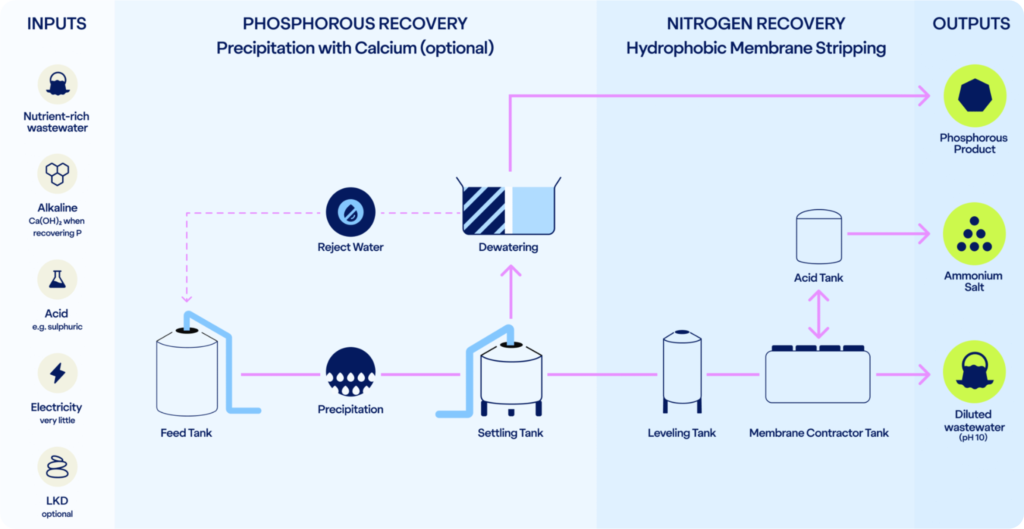
NPHarvest is not trying to make fertilisers sound greener. It is trying to change where fertiliser raw materials come from.
The company recovers nitrogen and phosphorus from concentrated wastewater streams, such as liquid digestate from biogas plants, reject water from wastewater treatment plants and liquid side streams from farms. The output is not vague “circular value”, but concrete fertiliser-grade inputs such as ammonium salts and calcium phosphate.
The idea is simple: where operators currently pay to treat, transport or dispose of nutrient-rich liquids, they could instead recover local fertiliser raw materials.
Europe is now flushing away something it then has to import, manufacture with fossil energy, or mine from the ground. This is the absurdity NPHarvest is trying to fix.
From Aalto University research to industrial technology
NPHarvest is a spinoff from Aalto University. The company was founded in 2023 after years of academic research, and is now commercialising the technology.
The system combines phosphorus recovery with membrane-based nitrogen recovery. Using its Nutrient Catcher technology, NPHarvest can recover up to 90% of both nitrogen and phosphorus from concentrated nutrient-rich liquid waste streams.
That combination is important.
Many existing solutions either remove nitrogen without creating a valuable product, recover only part of the nutrient stream, produce a mixed low-value output, or require high energy use and complex operation. NPHarvest’s claim is different: low operational cost, a cleaner end-product and modular integration into existing industrial infrastructure.
At full scale, biogas plants, wastewater treatment facilities and farms could become a permanent part of Europe’s fertiliser value chain.
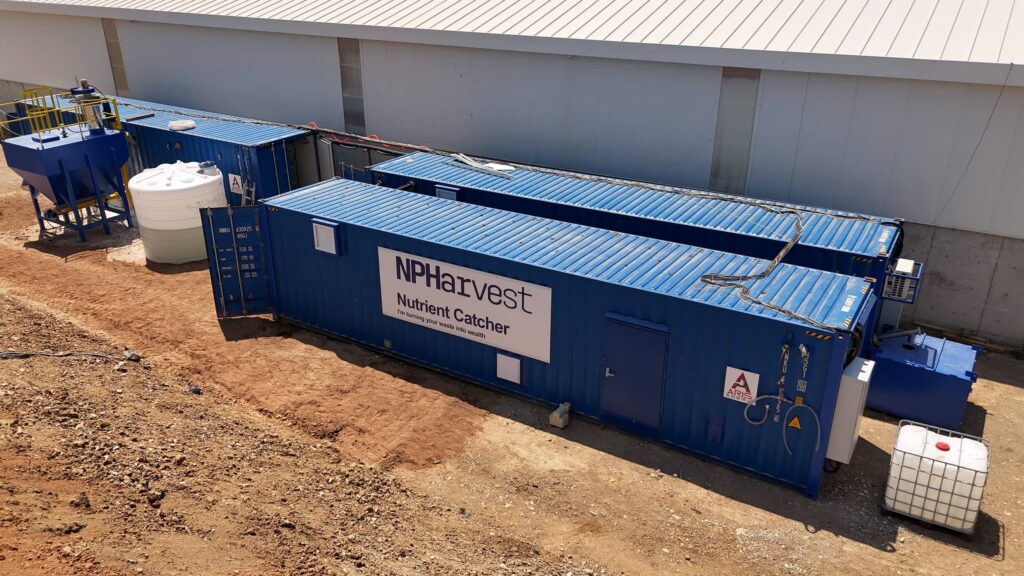
NPHarvest demo unit
The biogas sector has a nutrient problem
Biogas is growing in Europe, but the sector carries a less visible operational headache: digestate.
When organic material is converted into biogas, a nutrient-rich residue remains. That digestate can be useful, but it can also be expensive to manage. Nutrient application limits, local regulation, transport distances and tightening environmental rules all affect the economics.
In target regions, operators pay around €10–15 per cubic metre to dispose of these liquids. In some areas, the cost can be even higher. For a large plant, that adds up to a significant operating expense.
This is why NPHarvest’s commercial argument is stronger than a typical circular economy pitch. The company is not only selling environmental benefit. It is selling cost reduction.
If nutrients can be recovered on site, a biogas plant can reduce transport, lower its nutrient burden, improve compliance and create a usable fertiliser input from a stream that would otherwise cost money to manage.
The potential customer base is not small. NPHarvest identifies around 20,000 wastewater treatment plants and 20,000 biogas plants in Europe, alongside millions of farms that generate nutrient-rich liquid side streams. Across wastewater treatment, biogas and animal farms, the company estimates its European serviceable market at more than €30 billion by 2030.
One demo, and the market came to look
NPHarvest’s next important proof point is in Germany.
In spring 2026, the company deployed a 20 cubic metre per day demonstration unit at a biogas plant in Lower Saxony. The location matters. Germany is Europe’s largest biogas market, with thousands of plants facing rising pressure to manage digestate more efficiently.
The unit processes liquid digestate in a real operating environment. According to NPHarvest, the early results have been strong, and external laboratory checks have supported the company’s internal analysis.
After deploying the German demo, more than 20 potential customers lined up to visit the site. For a technology still at the beginning of commercial scale-up, that is a strong market signal.
In deep tech, real traction rarely looks like noise. It looks like customers showing up at an industrial site to see whether the system can solve their problem. That is now happening with NPHarvest.
Biogas operators do not need another abstract sustainability concept. They need a practical answer to rising digestate management costs, tightening nutrient regulation and the pressure to turn waste streams into something useful.
NPHarvest ran a real-world demo, and the sector noticed.
Europe is now looking for exactly this kind of solution
NPHarvest’s timing is unusually good. EU fertiliser policy is being pushed by several forces at once. Europe wants to reduce dependency on fertilisers from politically risky sources. Fertiliser trade is exposed to geopolitical shocks and shipping disruptions. At the same time, nutrient regulation is pushing wastewater and biogas operators away from simple disposal and towards recovery, reuse and circular nutrient management.
For NPHarvest, this means the market is not driven only by voluntary sustainability commitments. It is driven by cost, regulation, food security and geopolitics.
A good deep tech company usually needs three things: a large problem, a technical edge and a market that is ready to change. NPHarvest appears to be reaching the point where those three are beginning to align.
NPHarvest end products (photo Jari Härkönen)

Scaling from pilot to market with EriCa Reactor
NPHarvest is also part of the first EriCa Reactor cohort. The programme is organized by Crazy Town at EriCa Green Chemistry Park, with industrial partner Kemira supporting startups and research-based teams working on clean water, green chemistry and industrial sustainability.
The fit is clear. Nutrient recovery sits at the intersection of water, chemistry, industrial side streams and scalable infrastructure. For NPHarvest, the value of a programme like EriCa Reactor is not generic mentoring. It is access to conversations where the technology can be tested against industrial realities: process integration, chemical use, product quality, customer value, regulation and the wider value chain.
That matters because nutrient recovery is not just a machine sale. It touches operations, logistics, fertiliser markets, environmental compliance and industrial procurement.
Collaborating with dedicated hosts and coaches helps the team understand how the solution integrates into real-world industrial processes, and what is needed to move from pilot to market.
Those are the places where deep tech companies either scale or get stuck.
The next step: a €4 million seed round
NPHarvest is now targeting a €4 million seed round in 2026 to build its delivery organisation and commercial capability for the first full-scale installations.
The round is intended to help the company move from validated technology to repeatable deployment. That means delivering permanent units, improving unit economics, increasing the value of recovered nutrient products, growing the sales team and accelerating market entry through local expert partners.
For investors, the question is not whether nutrient recovery is becoming relevant. Regulation, fertiliser security and biogas economics are already pushing the market in that direction. The question is who can turn that pressure into working infrastructure.
That makes NPHarvest relevant to three audiences now.
- First, biogas plants, wastewater treatment facilities, farms and industrial operators with concentrated nutrient-rich side streams and rising disposal costs.
- Second, industrial partners who can support product quality, downstream processing, fertiliser market access, distribution or system deployment.
- Third, investors who understand deep tech and business field NPHarvest is operating in
Unlike many deep tech companies, NPHarvest is in a position to scale quickly thanks to strong market traction and an existing distributor network in its target markets. The company can build a defensible position as regulation, infrastructure and market timing increasingly move in the same direction.
NPHarvest is not solving a niche wastewater problem. It is making waste streams part of Europe’s fertiliser independence.
NPHarvest will be at the EriCa Reactor Demo Day on August 20, 2026 and team can be contacted at https://www.npharvest.fi/

Shared Labs at Crazy Town EriCa
Innovation and entrepreneurship require the right mix of:
- resources and infrastructure
- skills and expertise
- connections, partners and customers
- a supportive environment to keep moving forward
Coworking hubs have traditionally offered these for entrepreneurs and professionals working with laptops. But in deep tech, sustainability and chemistry-based development, progress ultimately depends on something very concrete:
You need a place to do research and development. A lab.
Crazy Town EriCa at EriCa Green Chemistry Park makes it possible for any kind of team, regardless of their stage or capital, to have access to labs with our shared labs service.
Shared Labs as a service
Shared Labs by Crazy Town EriCa gives you access to a professional lab environment without the need to build one yourself.
We combine:
- laboratory facilities, used by multiple teams and companies
- workspaces and meeting environments
- community-driven business development
Instead of building your own lab, you
- access ready infrastructure
- start immediately
- avoid upfront investment, risk before validation
- scale or downgrade when needed
- focus on building your solution without being slowed down by maintaining infrastructure.
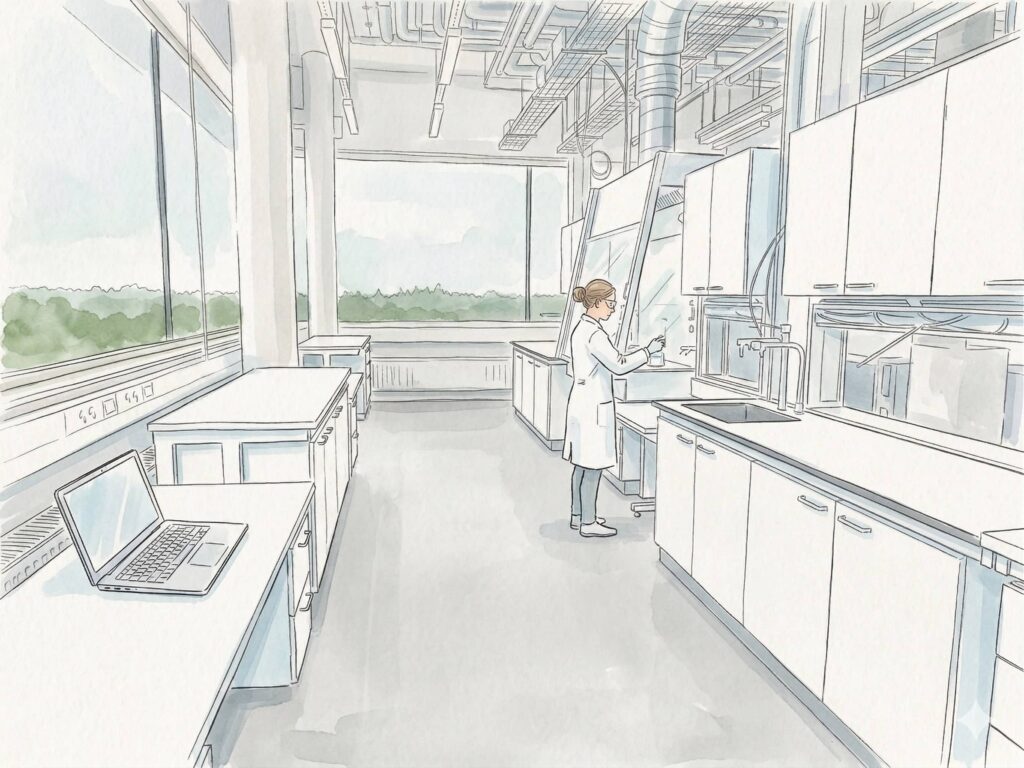
Shared Labs at Crazy Town EriCa are not limited to “green chemistry”
Shared Labs at Crazy Town EriCa offer a versatile environment that extends far beyond the scope of "green chemistry." Through our interactions with various customers, we have found that the facilities are ideally suited for building solutions across a broad spectrum of innovative fields. This includes everything from sustainable packaging and textile development to advanced battery and energy storage technologies. Our labs also support specialized work in space technology, mineral analysis, and the development of alternative proteins within the food technology sector.
Furthermore, the space is well-equipped to handle chemistry-based industrial solutions as well as general research into materials and industrial processes. Ultimately, if your work involves testing, validation, or technical development in a laboratory setting, there is a very good chance we can accommodate your specific needs and help your team progress.
One monthly membership gives you access to Shared Labs
We have two membership options to choose from
- Shared Labs: 690 € / month per lab bench. Scale according to your needs. Additional benches at a discounted rate.
- Shared Labs Plus: 2 500 € / month onwards. Fixed area.
These can be combined with traditional coworking use or a private office. For advanced startups and scaleups, opportunity to continue or select a Private Lab at EriCa.
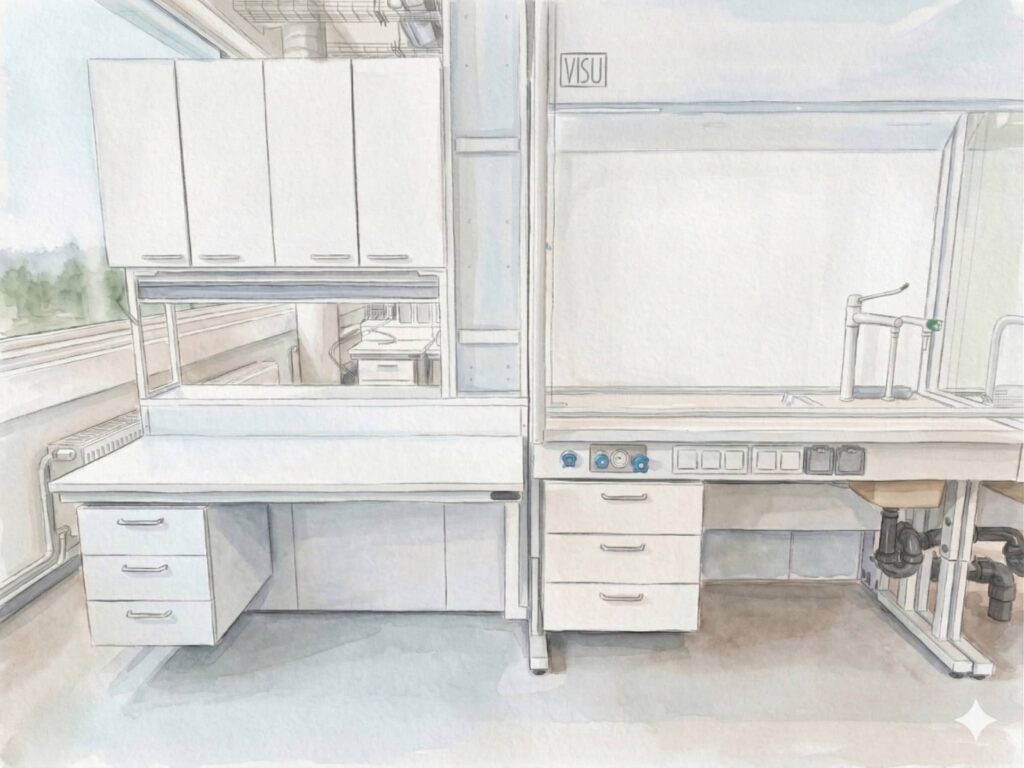
What you get at Shared Labs?
Laboratory infrastructure
- Fume hoods
- Workbenches
- Cold, warm and RO water
- Compressed air and nitrogen supply
- Safety systems and chemical storage
Equipment and facilities
- Refrigerators and freezers
- Laboratory scale
- Fire safety cabinets
- Corrosive storage / acid–base cabinets
- Instrument washers and drying cabinets
Services
- Gases based on usage
- Maintenance and cleaning based on usage
- 24/7 access to the laboratory
Workspace and environment
- 24/7 access to Crazy Town EriCa coworking floor
- Professional address and HQ-level environment
- Access to Meeting Hub for customer, partner and stakeholder meetings
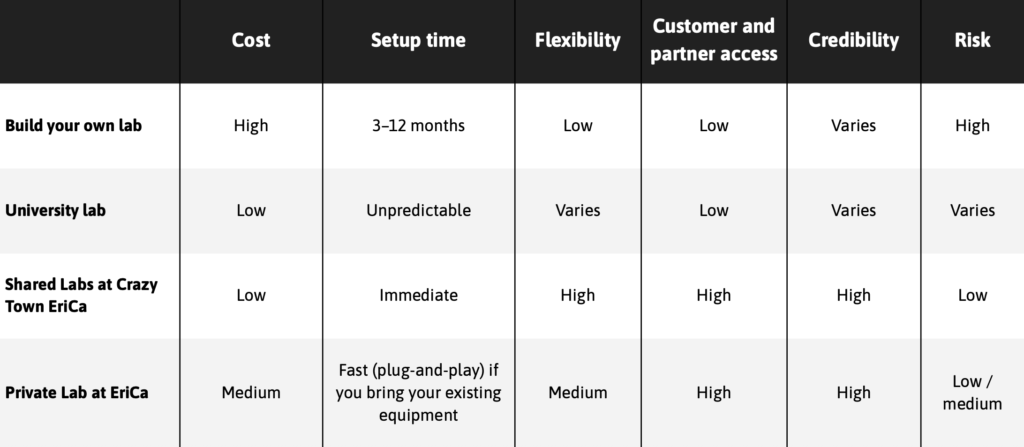
How does it compare to alternatives?
How to get started?
Getting started begins with seeing the concept in practice, which is why we recommend booking a tour as your very first step.
Before you arrive, take a moment to define your specific needs. You should be clear about what stage your business is in, why you need a lab, and how frequently you’ll use it. Consider the technical requirements of your development, such as specific equipment needs, including whether you plan to bring your own, and how your team balances time between the lab and the office. Being prepared to describe your roadmap and business goals will help tailor the experience to you.
Once you have a clear picture of your requirements, visit to see the space firsthand. This is the best time to discuss your specific use case and evaluate which setup fits your workflow. We generally suggest that teams start small rather than trying to build a full setup from day one. You can begin by testing assumptions and validating your early work in our Shared Labs for occasional use, or Shared Labs Plus for more continuous work. Starting this way allows you to scale or upgrade your membership as your project gains momentum.
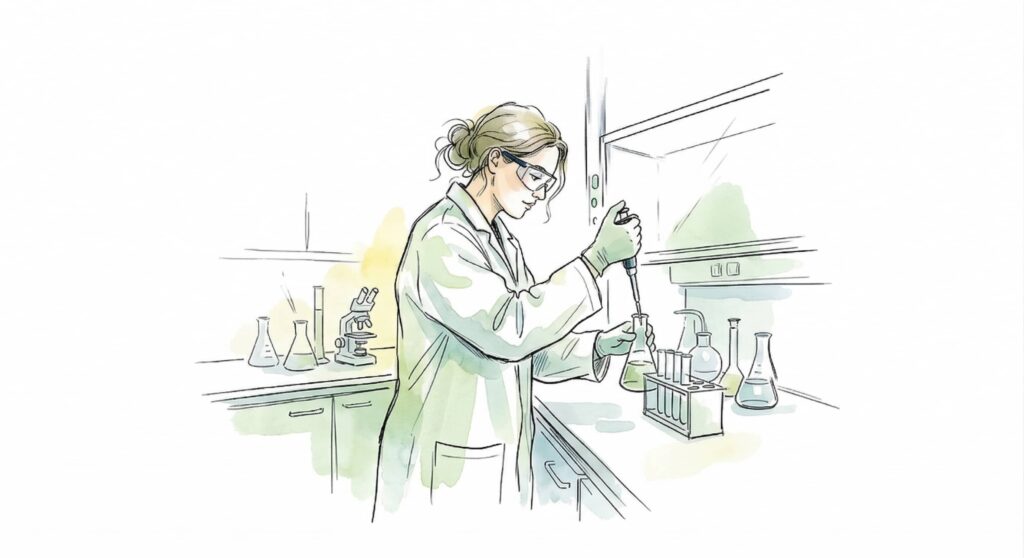
A successful strategy involves combining lab work, office tasks, and business development. Most teams don't actually need to be in the lab full-time, so we encourage using the lab only when necessary and utilizing our workspaces for analysis, planning, and meetings.
Additionally, you can leverage your membership to connect with the community and build valuable professional relationships. As your work progresses, our flexible model allows you to scale whenever needed by adding or removing users, moving to a dedicated area, or transitioning into a private lab when your development requires it.
To explore Shared Labs at Crazy Town EriCa, book a tour by contacting
Oona Sulkunen, +358 400 634, oona.sulkunen@crazytown.fi
Pavel Popov,+358 40 044 1973, pavel.popov@crazytown.fi
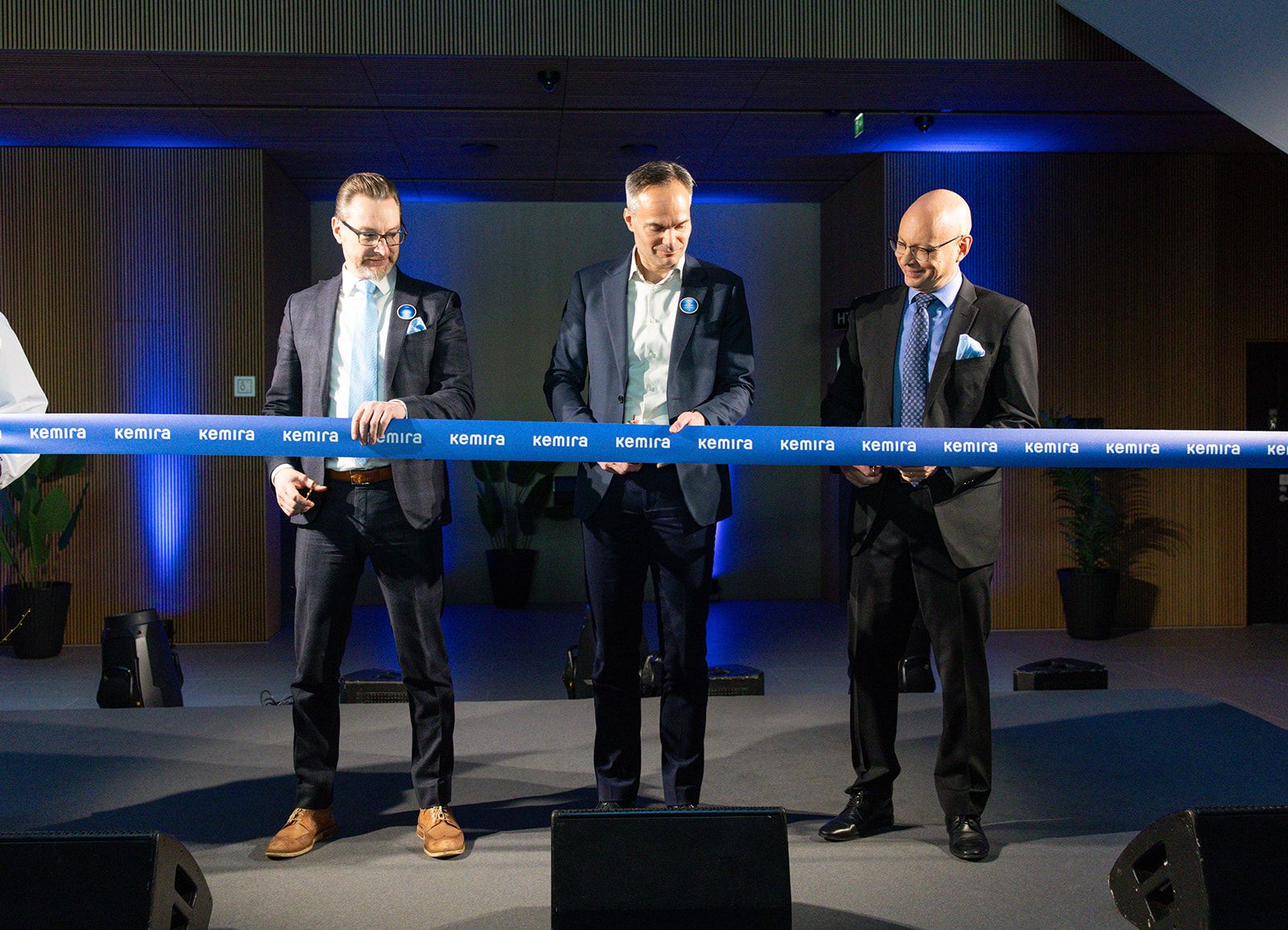
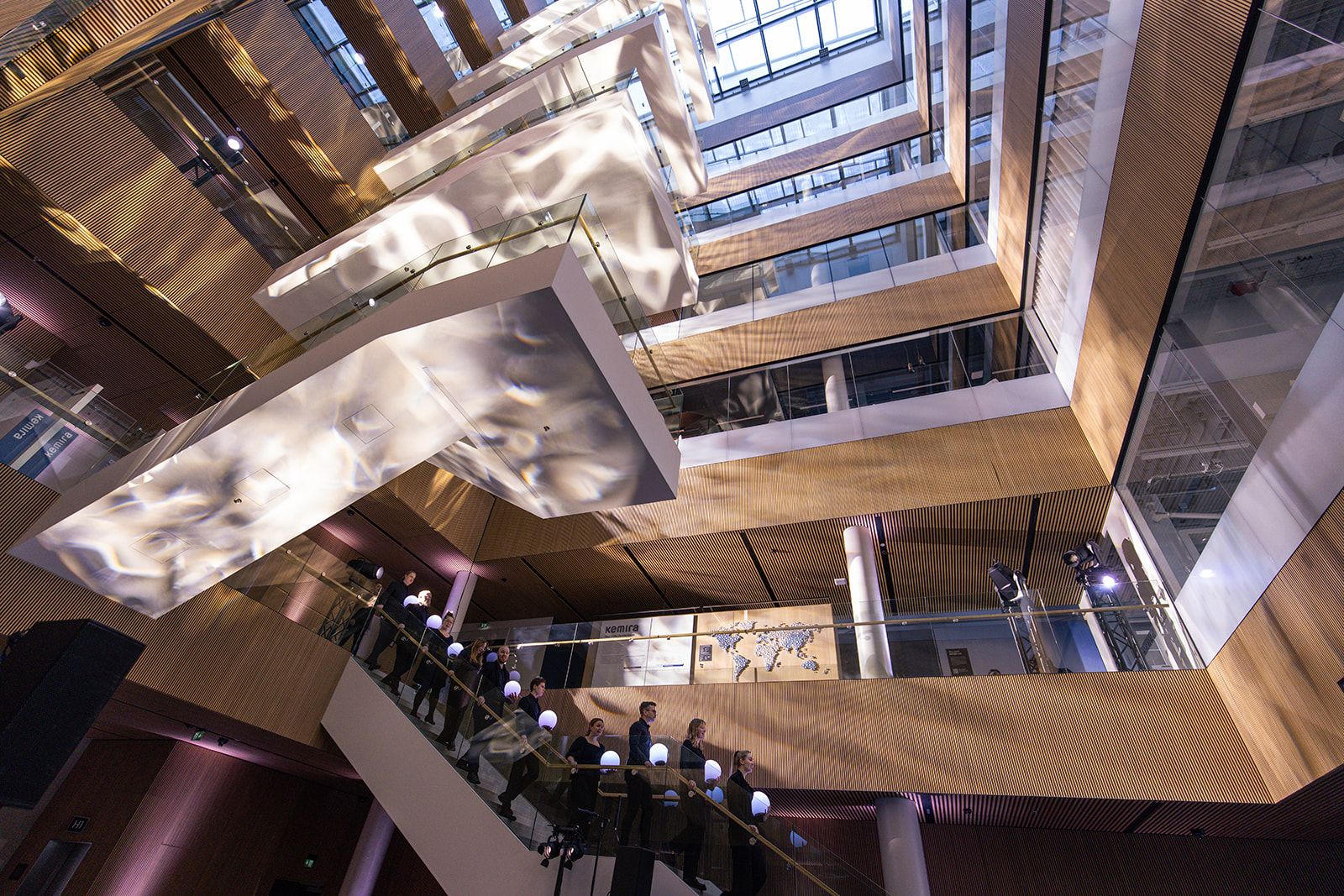
Kemira Espoo Innovation Center officially opened
EriCa celebrated the opening of the Kemira Espoo Innovation Center on January 29, 2026 at EriCa Green Chemistry Park, its home. As one comment put it: “This is where customers, technology, and science meet.”
Under the award-winning roof of EriCa stands Kemira’s global innovation hub, equipped with state-of-the-art laboratories and talent to tackle some of the world’s most pressing challenges.
The opening ceremony featured remarks by CEO Antti Salminen, Mayor of Espoo Kai Mykkänen, and EVP, Research & Innovation Sampo Lahtinen. During the discussions, one point kept coming up: “Everyone in the value chain needs to collaborate. We need faster innovation cycles and commercialization.”
Walking through the seven floors on a tour, another observation from the opening speeches felt particularly on point: “The new innovation center is an investment in talent development. People bring spaces to life. Otherwise, they are just empty walls and equipment.”
Mayor Mykkänen emphasized that EriCa and the Kemira Innovation Center are part of Green Line, a deep tech hotspot where Finland builds local solutions to global problems.
During the tour guests found out that today Kemira’s solutions help provide clean and safe water for 400 million of people worldwide. But how do we help everyone access it? After all, making water dirty is free, cleaning it is not. That is one of the shared challenges for us.
EriCa Green Chemistry Park is happy to be part of the journey. Congratulations to Kemira and the entire team for the official opening.

Press release: EriCa Reactor accelerates green innovations from lab to market
EriCa Reactor is an accelerator program that takes green innovations from lab to market in partnership with world-class industry leaders.
The sustainability crisis is too complex for anyone to solve alone. EriCa Green Chemistry Park is a hub and home to an ecosystem, where talent, startups, and industry collaborate to accelerate a resource-efficient and sustainable future.
The EriCa ecosystem is open to those working to ideate, innovate, and collaborate for growth together with like-minded peers. The approach is a people-first, high-trust community.
“What makes EriCa special is how it brings together world-class partners at one hub, with shared R&D labs easily available even for early-stage startups in proximity with industry partners. We’re in the epicenter of one of Europe’s leading deep tech ecosystems that we have here in Finland,” says Toni Pienonen from Crazy Town, the operator of EriCa Green Chemistry Park. At the heart of EriCa is the social capital.
“Most importantly, we’re building a community of experts. Innovation grows when people build trust, share knowledge, and open doors for each other. This community-driven approach defines the ecosystem and builds on 20 years of experience in nurturing entrepreneurial communities.”
To accelerate impact, EriCa runs innovation activities with global industry partners. Its flagship program EriCa Reactor helps to bring innovations and technologies from lab to market, around themes such as:
- Ensuring clean water
- Enabling circularity and material recovery
- Replacing fossil-based raw materials
- Accelerating decarbonization
- Advancing industry digitalization
The first EriCa Reactor cohort will focus on ensuring clean water, with Kemira as the lead partner
The first program cohort will run from March to August 2026. Kemira, a global leader in sustainable chemical solutions for water-intensive industries, has its global innovation center onsite at EriCa Green Chemistry Park and is the lead industry partner for EriCa Reactor and its launch.
Today, over two billion people lack safe water, while climate change, population growth, and contaminants like microplastics increase pressure on water resources. Kemira seeks to explore innovations that address these challenges. Startups, scaleups, and spinoffs developing clean water solutions are invited to apply. Examples include new technologies and chemical solutions in water treatment and purification, or digital tools such as AI and IoT for sustainable water management. The program welcomes a wide range of approaches from around the world.
“Kemira’s innovation strategy focuses on bringing together chemistry expertise and advanced digital solutions to address some of the defining issues of our time: water resilience, climate change and circularity,” says Kemira’s Sampo Lahtinen, EVP, Research & Innovation. “We believe in succeeding together with our strategic partners and customers, and we’re excited to join forces with startups through EriCa Reactor. Together, we can explore breakthrough solutions and help promising companies scale globally, leveraging Kemira’s long experience and deep expertise in water-intensive processes.”
Selected companies benefit from:
- Hands-on mentoring and insights from industry experts, investors, and business developers
- Opportunities to work alongside leading industry R&D teams
- Customer understanding and insights
- Understanding of what scaling to global markets requires
- Peer-learning with fellow participants and matchmaking
- Full EriCa Green Chemistry Park membership, including 24/7 access to coworking and lab facilities in Espoo, Finland
Eligible participants should have a novel, scalable technology and business model, initial funding or support, and an ambition to expand globally. Startups bring agility, Kemira brings scale.
Teams selected for the program will receive dedicated growth support within Espoo’s globally recognized deep tech hotspot, a hub of innovation at the forefront of sustainability, water, and green chemistry.
Applications now open – apply by December 31, 2025 for the first cohort
EriCa Reactor runs twice per year in a hybrid format. The first cohort starts in March 2026 with a kickoff event in Espoo, Finland.
Startups, scaleups, and spinoffs are invited to apply. EriCa is also open for ecosystem partners globally to co-create a better future.
For more information and to apply, visit: https://ericagcp.fi/reactor
CONTACT DETAILS
Crazy Town Oy
Toni Pienonen, Partner
toni.pienonen@crazytown.fi
+358 400 737 238
Kemira Oyj
Jenni Vuorela, Communications Manager
jenni.vuorela@kemira.com
+358 40 186 4094
EriCa Green Chemistry Park, located in Espoo, Finland, a pioneering hub in green chemistry and sustainable development. It offers state-of-the-art facilities for research and development in the chemical industry and brings together leading players, startups, and research institutes in the field. https://ericagcp.fi/
Crazy Town is the operator of EriCa ecosystem and EriCa Reactor. It is one of Europe’s oldest innovation community-builders. www.crazytown.fi
Kemira is a global leader in sustainable chemical solutions for water-intensive industries. We deliver tailored products and services to improve the product quality, processes, and resource efficiency of our diverse range of customers. Kemira is listed on the Nasdaq Helsinki. www.kemira.com