

From the Ecosystem – You already do this for engineering. Why not for your buyers?
This text is written by Elina Chung, a founder of Elina Chung Oy and a member of Crazy Town Jyväskylä and the EriCa ecosystem.
A decision made on taste
A few years ago I watched a product decision get made because someone liked the way Instagram looked.
Someone senior wanted it to feel more like a consumer app. He would point at the Instagram logo as the model for ours. It was a B2B tool for documenting processes and organising how teams structured their work. At the time, nobody had settled who the ideal customer was, or fully agreed on what the product was for.
Wanting a well-designed product is reasonable. What stood out was the reasoning behind the specific choices: not what would help a customer use the thing, but personal taste. Decisions got made on preference, not on what the product could do, or what it was worth to the people meant to buy it. The question of who it was for had been left open. The strongest opinion in the room filled it.
The company was a scale-up, still testing the market, and it later went through a significant round of layoffs.
What was missing wasn't design sense. It was anyone asking what we actually knew. The influence was real, and it had been earned somewhere: in starting the company, in putting money behind it. But it was being spent somewhere it hadn't been earned, on what an undefined buyer would want from a product we hadn't finished defining.
What engineering already does
Engineering teams have a process for exactly this. After an outage or a failed experiment, a blameless postmortem asks what was known at the time versus what was assumed, and nobody asks whose fault it was. Plenty of companies run that process for engineering. I have never seen one run it for a lost deal, a launch nobody noticed, or a market they entered and quietly backed out of.
I have seen the other version too. At a company I joined later, the ad and agency spend was substantial, but leads either weren't coming in, or the ones that did weren't worth much. The agency's answer was to spend more. Nobody was asking whether the leads were any good.
We stopped spending. Before touching anything else, we worked out who we were selling to, and found three groups sitting under one label, "IT decision makers".
The person evaluating it was reviewing it on technical merit. The people who would use it every day were asking something narrower: does this fit the way I already work, and how does it sit alongside the stack I already have. They rarely thought about how it would benefit the business. The person signing it off understood the product too, but valued it differently again, on what it did for the organisation's governance and risk position, and ultimately the bottom line.
Same product, three different questions, and we had been sending all of them the same words.
We split the messaging to speak to the evaluator and the person signing it off, and deliberately left the users out. In firms that size they weren't making the decision. They were stakeholders in it, and part of the feedback loop once the product was in, which is a different job needing different words. Deciding who not to talk to is part of the same exercise.
With that settled, we worked directly with the agency on the copy. Qualified lead volume improved by roughly 30% over the first year. Not a dramatic number, but a real one.
The three questions
Every time I have done this, it has come down to the same three. Who are we really selling to. What are we selling them. Where are those people looking. Answer those honestly and most of the operational decisions, the channels, the budget, the agency, follow from them. Get them wrong and nothing downstream rescues it.
The honest part is the difficult part. The teams I've asked can answer all three quickly. That speed is the problem, because the quick answer is usually the assumption rather than the knowledge. A useful review separates the two: what did we know, and how did we know it, against what did we believe because nobody had questioned it. Then one follow-up for each belief. What would we have to see to know this is wrong?
None of this needs to be a project. An hour with whoever was in the room, no names, no fault, one page of notes. The output isn't a document. It's one assumption you have agreed to test before the next decision.
A version, not a conclusion
One more, and this one ends better than it starts. A company with a premium product and a strong position at home expanded into a new region, using largely the playbook that had worked there, slightly reframed. Positioning and messaging had never been worked out for the new market specifically. Locally, the sales team was under constant pressure to discount and undercut competitors, because the commission structure rewarded the number of deals closed, not the value of each one. Over time that wore down the premium positioning, and marketing's return fell to almost nothing.
Nobody set out to damage the brand. The incentive structure rewarded one thing, volume, while the actual goal, healthy and valuable deals, was never built into how success was measured.
You could hear it in how people described their own work. When sales raised the quality of the leads, one marketer's answer was that their job was to bring in volume, not to qualify it. It landed as arrogance. It was also an accurate description of the role as it had been defined. Volume was what the work was measured on, so volume was what the work produced. That’s what an incentive problem sounds like from the inside: no decision anyone can point to, just people doing the job they were given.
The correction was expensive, and it was quick. Half the marketing team went, along with some of sales. It's worth noticing where the cut landed. The function that couldn't show a return was the one that shrank. I was in it.
Then the direction changed. The discounting stopped. The money that had gone into undercutting competitors went into building credibility with voices the industry already trusted, to build the standing it had assumed it already had. The company repositioned itself and carried on. Getting it wrong wasn't fatal. Not noticing could have been.
Some companies never do any of this and survive anyway. If you sell something inexpensive to a very large number of buyers, you can afford to guess repeatedly and let volume find the answer for you. Unfortunately that isn't available to you if the sales cycle is long, the pilots are expensive and the number of possible buyers is smaller. Then you get a limited number of attempts. Decide beforehand what each one is meant to test, or it will teach you the wrong thing as easily as the right one.
The one question worth adding
Treat your view of the market the way you already treat your product: as a version, not a conclusion. A product still finding its buyers is in beta. So is everything you believe about those buyers, including the price you put in front of them. A price set for a market you haven't entered yet is an informed estimate, not a fact: you make the best call you can, then test it and adjust quickly when the evidence says otherwise.
Three companies, the same root cause each time: a belief about the market treated as settled fact instead of something to check. The method isn't complicated, and it isn't new to you. Pause, ask what was known, review without blame, adjust. You already run it on the technical side of the business. The harder question is what stops it reaching the room where decisions about buyers, positioning and price get made.
Next time something you were sure about turns out to be wrong, the useful question isn't whose fault it was. It's whether you knew, or you assumed.
Elina Chung
Elina Chung Oy
 Elina Chung runs Elina Chung Oy. She works on international B2B market strategy: who you sell to, what you sell them, and why it lands. Twelve years in-house in B2B technology, including SaaS, cybersecurity and health technology, in Australia, Asia-Pacific and EMEA. She mentors on EriCa Reactor.
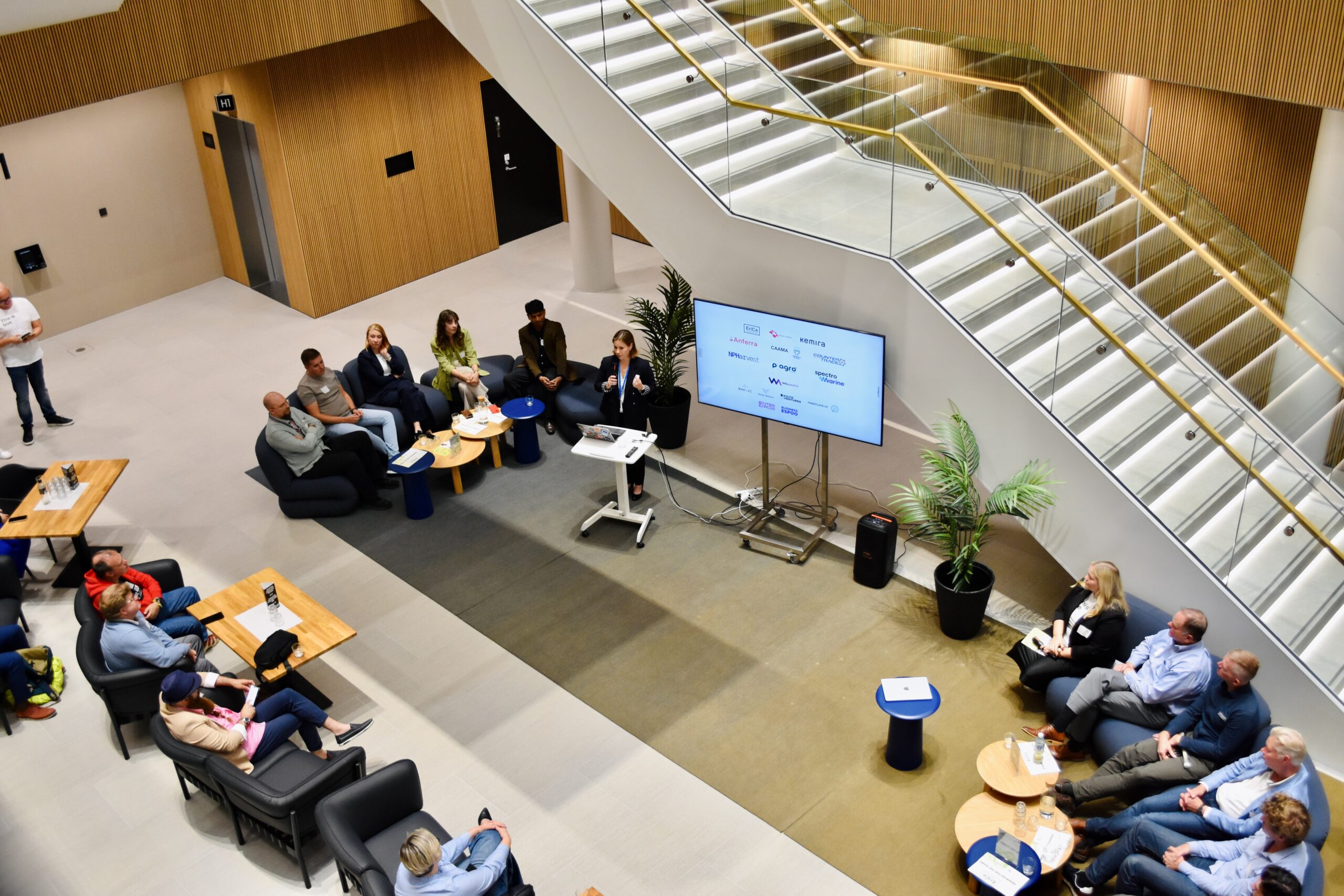
First Results from EriCa Reactor: Funding, Pilots and Continued Collaboration
What can happen in five months when deep tech teams work directly with industry experts, investors and other startups?
The first EriCa Reactor cohort gives some early answers: more concrete pilot plans, clearer market focus, stronger business models, new investor and industry connections, funding, and continued collaboration beyond the program.
EriCa Reactor is an accelerator operated by Crazy Town at EriCa Green Chemistry Park. Kemira, a global leader in sustainable chemistry for water-intensive industries, serves as the lead industry partner for the first two cohorts.
The first cohort ran from March to August 2026 and brought together seven startups and research-based teams developing clean water solutions from five countries:
- Anferra, Sweden
- CAAMA / University of Oulu, Finland
- Countertrace, USA
- NPHarvest, Finland
- P-Agro Minerals, Latvia
- Spectromarine, the Netherlands
- Wellmatix, South Korea
The aim was to help the teams move from lab to market — towards industrial validation, pilots, customers and commercialization.
During the five-month program, teams received 1:1 coaching from Kemira experts, peer support, facilitated workshops, investor introductions and access to the EriCa ecosystem.
The first results suggest that the value was not only in individual meetings or workshops. For many teams, the collaboration changed what they decided to focus on next.

From pilot ideas to concrete validation plans
For several teams, one of the main goals was to prepare for industrial-scale testing and piloting.
Working with industry experts helped turn high-level pilot ideas into more concrete validation plans. Teams received support in defining what data industrial partners would need, which KPIs and technical specifications should be monitored, how results should be analyzed, and what would need to be demonstrated before moving forward.
For some teams, this resulted in detailed pilot or prototype validation methodologies. It also helped clarify the right sequence of commercialization activities: whether the next priority should be sales, technical scaling, validation or collecting further data for future customer discussions.
That kind of clarity can be highly valuable in deep tech development. It helps teams understand not only what to do next, but also what may still be too early to pursue.
Sharper market focus and stronger business models
Technology development is only one part of commercialization. Teams also need to understand where their technology creates the most value and which applications are worth pursuing first.
During the program, teams worked on their market position, value proposition, customer needs and priority applications. For some participants, this meant narrowing down a broad set of potential use cases and focusing on the ones with the clearest customer need and commercial potential.
The collaboration also supported business model development.
For one team, discussions during the program contributed to a pivot towards a new business model. This raised practical questions around customer agreements, responsibilities, risk sharing and how to structure an arrangement that works commercially for both parties.
Industry experience provided useful insight into these questions and into what should be considered when negotiating with customers. The goal was not simply to refine a business model on paper, but to develop an approach that could work in real industrial customer relationships.
Access to expertise, industry and investors
For early-stage deep tech companies, access can be as important as advice.
Several teams highlighted that the program helped them build connections and enter conversations that would otherwise have been difficult to access independently.
Investor introductions opened doors to new discussions, while interaction with Kemira gave teams access to technical and industry expertise in areas such as water treatment, chemistry, industrial applications and piloting.
The value was not simply in introducing startups to a large company. The program created a setting where both sides could explore technologies, applications and commercial opportunities in sufficient detail to identify whether there was potential for further collaboration.
At the same time, Kemira was able to explore how its own chemistry and technical expertise could complement the technologies and innovative products developed by the participating teams.
Funding, new capabilities and continued collaboration
The program also contributed to tangible company-level outcomes.
During the first cohort:
- teams secured combined over 2 M€ of financial investments and funding for further piloting and development
- concrete plans for continued development collaboration with Kemira and other industry partners progressed
- a team recruited a new person to lead commercialization
- an international company established a Finnish entity and gained a home base at EriCa
- teams gained new investor, industry and ecosystem connections
 The industry partner learns too
EriCa Reactor is not designed as a one-directional coaching program. The idea is that startups and industry work together, and both sides learn.
For Kemira, the first cohort provided insight into the entrepreneurial mindset and working methods of early-stage technology companies, including agile ways of working, strong focus and energetic and proactive approach to tackle challenges. Kemira gained insights on how startups prioritize activities, engage investors, rapidly test business concepts, and adapt to customer requirements under resource and time constraints.
The collaboration also created opportunities to evaluate how Kemira’s existing chemistries, technical expertise and capabilities could be combined with emerging startup technologies in different water treatment related applications.
The five-month program resulted in concrete plans for continued development collaboration and Kemira sees lots of potential for future projects. More about these collaborations will be shared as the time is right.
What did we learn?
The first EriCa Reactor reinforced the idea the program was built around: Deep tech commercialization does not happen in isolation.
A strong technology is not enough. Teams need real use cases, customer understanding, industrial expertise, technical validation, industrial piloting, funding and access to organizations that can help them take the next step.
For the first EriCa Reactor cohort, the program’s end was therefore not the end of the process. It was one milestone in a longer journey that continues through pilots, development projects, investment discussions and new partnerships.
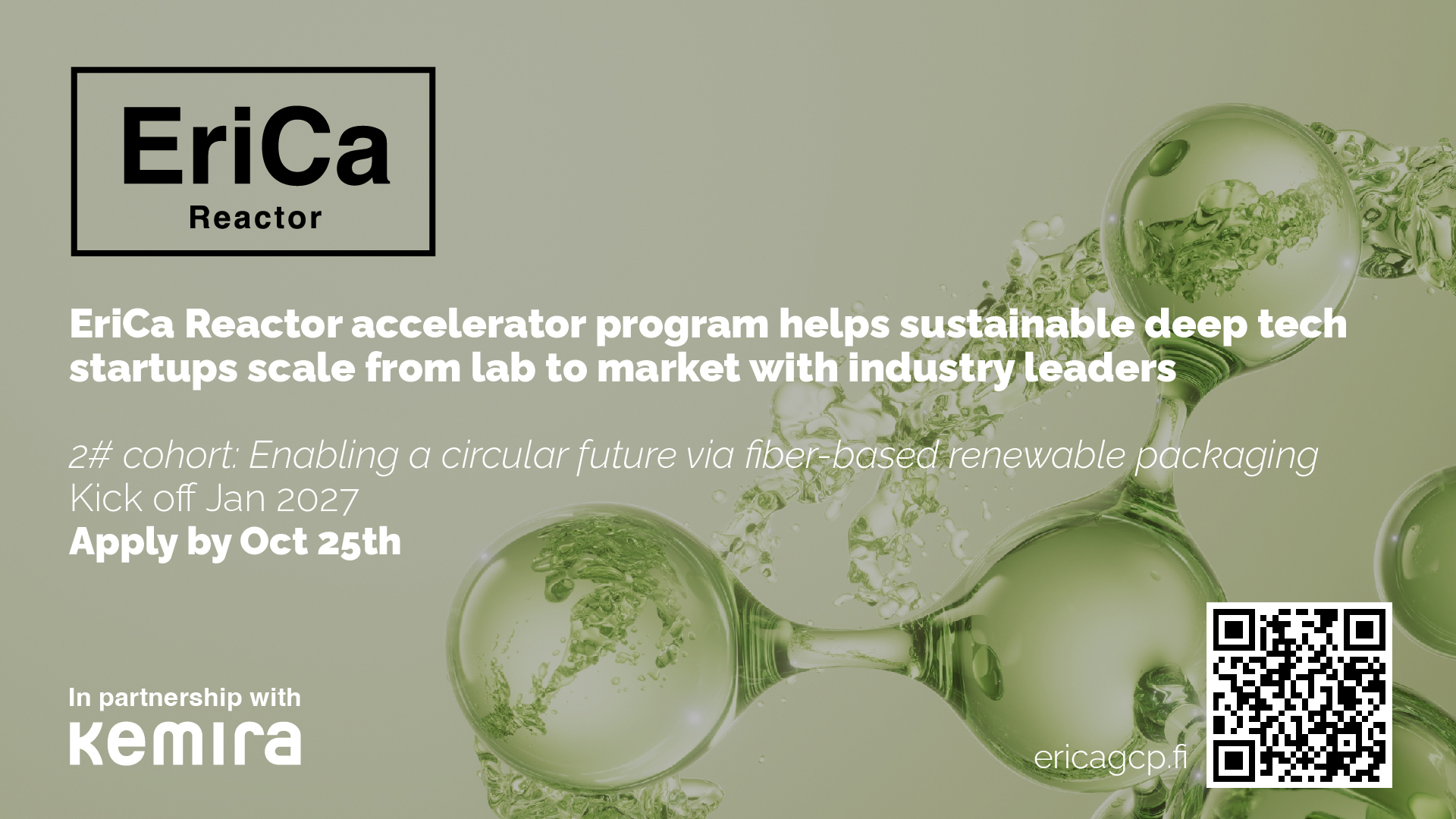 Next: renewable fiber-based packaging
EriCa Reactor is now preparing for its second cohort together with Kemira under the theme:
“Enabling the Future of Circularity with Renewable Fiber-Based Packaging.”
The program is looking globally for 6–8 startups, scaleups and research-based spinoffs developing innovative solutions related to packaging and the fiber industry.
Applications are open until 25 October 2026.
Learn more and apply: https://ericagcp.fi/reactor
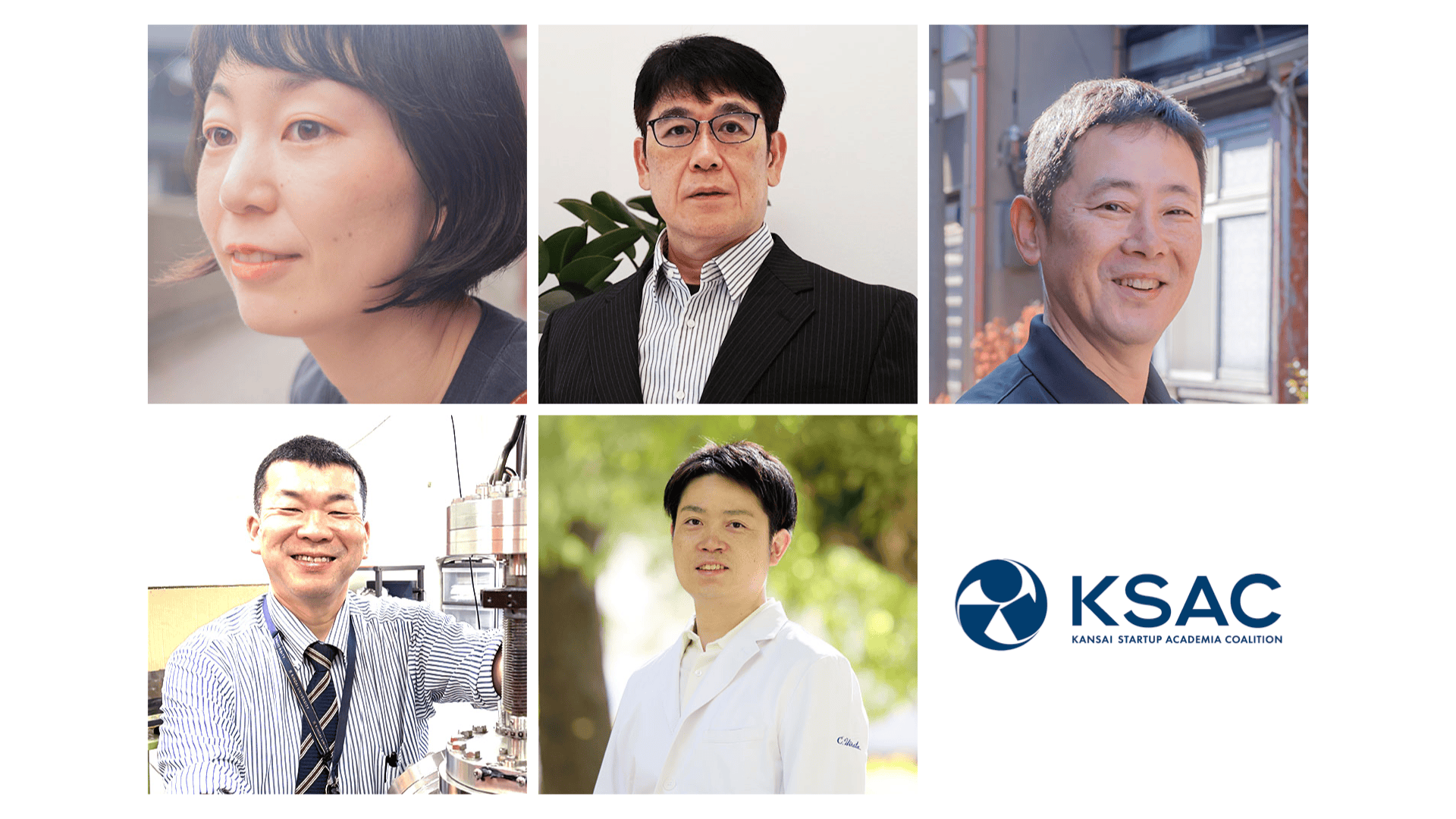
Five Japanese researchers seek Finnish partners to bring innovations from lab to market
Scientific research can help address global challenges. Turning discoveries into useful products and services takes business expertise, testing and partners. This October, five Japanese researchers will visit Finland to explore how Finnish expertise could help move their work forward.
The KSAC Finland Program brings the researchers to Espoo and Helsinki on 19-23 October 2026. Selected through an application process, they are exploring commercial opportunities for research in water reuse, biodegradable materials, wearable sensors and new treatments.
Finland’s connections between universities, research organisations and companies provide a setting for this work. The programme introduces participants to Finnish partners and helps them assess different routes to market, from starting a company to licensing technology or working with an established business. For Finnish organisations, the visit is an opportunity to find research that could support their own development work and build connections with universities and innovation organisations in Japan.
Crazy Town, the operator of EriCa Green Chemistry Park, is involved as the Finnish coordinator for the program and will also bring the researchers to EriCa.
From research to practical use
The five projects address different problems, but each faces a common question: what will it take for the research to become useful outside the laboratory?
The participants are at different stages of answering that question. Some are exploring possible applications and business models, while others are further along in developing their plans. During the visit, they will meet Finnish experts to discuss market needs, development challenges and possible next steps.
Finnish companies can contribute knowledge of customers, market needs or industrial requirements. Researchers can identify opportunities for joint work and testing. Investors and business development experts can help clarify what evidence and capabilities a project needs before it is ready for investment.
These discussions could lead to joint research, preparation for a pilot or a clearer understanding of where a technology has commercial potential. The programme aims to help participants identify a useful next step and the people who could help them take it.
The five researchers and their work
Haruka Takeuchi — Kyoto University
Takeuchi is developing decentralised water treatment and reuse systems. The aim is to allow water to be treated and reused locally, supporting more sustainable water use.
Shu Ishikawa — Kobe University
Ishikawa is developing uLtra-PGA, a biodegradable polymer produced by fermentation. The initial focus is on cosmetic ingredients, with potential for later use in medical and industrial applications.
Motoshi Sobue — Nara Institute of Science and Technology, NAIST
Sobue is developing a treatment approach aiming for lasting therapeutic effects in conditions such as Parkinson’s disease and drug addiction. The underlying technology also has potential for more immediate applications in other areas.
Hiroaki Nishikawa — Kindai University
Nishikawa is developing thin ceramic films that retain their functional properties while bending. These materials could be used in wearable sensors that monitor signals from the body.
Chuji Hirota — Osaka Medical and Pharmaceutical University
Hirota is part of a team developing a scaffold to support the regeneration of joint cartilage. The approach aims to enable repair in a single procedure without donor tissue.
Read more about the researchers and their projects here.
Building connections that last beyond the visit
The Finnish programme is coordinated and facilitated by Crazy Town, together with Enter Espoo, VTT, Aalto University and other partners, including Helsinki Partners.
Commercialising research also takes trust between people. The programme helps researchers build this social capital through meetings, shared learning and informal conversations. Getting to know each other makes it easier to discuss uncertainties, ask for help and continue working together after the visit.
During Espoo Innovation Deep Dive on 19–22 October, Enter Espoo introduces relevant local organisations and networks. VTT shares its experience in research commercialisation, while Crazy Town helps participants learn from each other, meet potential partners and identify next steps. Aalto Startup Center welcomes the researchers to 100STARTUPS on 21–22 October, where they can meet founders and other participants.
Helsinki Partners supports KSAC in hosting a pitching event 23 October, where the researchers will present their work and meet potential collaborators through one-to-one meetings and networking.
Meet the researchers in October
Finnish companies, researchers, investors and organisations supporting research commercialisation are invited to meet the participants.
To explore a meeting during the visit, contact the Crazy Town programme team at projects@crazytown.fi
Tell us which project interests you and what you would like to discuss. Suggestions for relevant contacts are also welcome.
Two open events offer an opportunity to meet the researchers and learn more about their work:
20 October, 16:00–18:30, Espoo | Japan–Finland deep tech afterwork
An informal gathering at EriCa with the researchers, KSAC representatives and Finnish participants. Join to exchange ideas and discuss opportunities for cooperation. Details and registration >>
23 October, 10:00–15:00, Helsinki | Japanese Researchers’ Pitch & Meet-up
KSAC and Helsinki Partners host a day of researcher presentations, networking and individual meetings. Programme and registration >>
About KSAC
Kansai Startup Academia Coalition (KSAC) supports entrepreneurship and university-based startups in Japan’s Kansai region. It brings together universities, companies, financial organisations and local governments to help research reach practical use and international markets.