
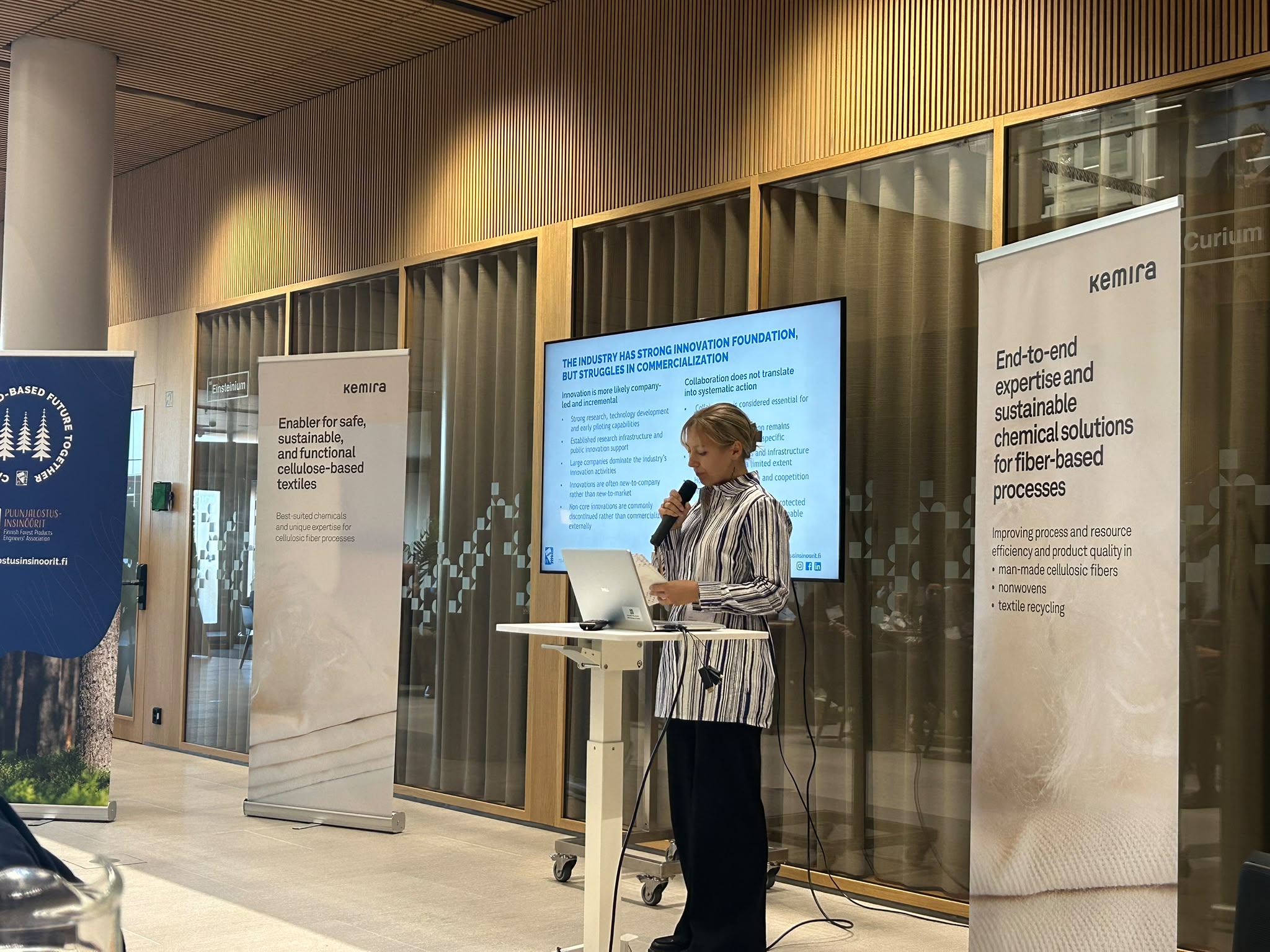
From the Ecosystem - Ecosystem level problems need ecosystem level solutions
A recent Master's thesis from LUT University, commissioned by Puunjalostusinsinöörit (PI), examines the barriers preventing promising technologies from reaching industrial scale and highlights the importance of stronger collaboration between researchers, startups, industrial companies and investors. The findings are closely connected to EriCa's mission of accelerating green innovations from lab to market, which is why we wanted to share these insights with our community and wider network.
This article is based on a Master’s thesis at LUT University in 2026.
Ecosystem level problems need ecosystem level solutions
The Finnish forest industry is facing a transition due to changing markets and the growing need to develop more radical innovations. Although Finland has strong research capabilities, a developed startup ecosystem, established forest industry actors, and public support for innovation, many promising forest-based innovations encounter difficulties when progressing from research and development to industrial-scale production and commercial markets. My thesis set out to examine how the Finnish forest industry's innovation environment can be developed to support the commercialization of forest-based innovations. A total of 14 industry experts were interviewed from business, finance, and research and education institutions to gain insights from different perspectives.
Strong actors, fragmented collaboration
The concept of ecosystems was used as a way of better understanding the innovation environment and its opportunities. The findings indicate that Finland possesses the actors and resources needed to develop a functioning forest industry innovation ecosystem, but the presence of these actors does not guarantee interaction between them. Currently, collaboration between industry actors remains fragmented due to the industry's path dependency, cultural risk avoidance, and lack of mutual trust.
On this basis, the Finnish forest industry behaves more like a traditional, fragmented industrial cluster than an innovation ecosystem. A recurring insight across the research is that ecosystem actors tend to recognize the same underlying problems but rarely share responsibility for solving them. The main challenge in commercializing forest-based innovation is therefore not the invention itself but repeatedly its ownership.
Where innovations get stuck
The commercialization process is particularly constrained at the transition from pilot scale to industrial demonstration. This phase is the most significant valley of death in the commercialization process, because industry projects require massive capital investments with an uncertain return and current risk-sharing models are inadequate. Domestic private capital is limited, which is why bridge financing from technology
readiness level (TRL) 5 onwards was one of the most common industry needs.
Startups in particular face a chicken-and-egg paradox, where potential customers prefer technologies that have already been proven at industrial scale, but proving the technology often requires a demonstration facility. However, in order to gain investment, many financiers require secured customer commitments as proof of real market demand, which means funding for the facility is considerably harder to gain before customers have committed to buying.
Currently existing demonstration facilities are concentrated within large corporations that often maintain strict control over access to their premises. Many large companies run costly pilot facilities alone at low utilization, due to the culture of the industry, which makes innovation development slower and more expensive for heavy industry.
For a startup, the situation is even harder, because building its own pilot equipment would require a major investment and access to existing facilities is tightly controlled. The bottleneck between pilot and industrial demonstration is itself a symptom of missing ecosystem mechanisms rather than a lack of underlying resources or technologies, and no single actor has the reach to fix it alone.
Startups should be viewed as partners, not as competitors
At the moment, cooperation between large companies and startups is fragmented. Companies often become interested in startups only after they have proven the profitability of their business through customer relationships, and they may consider the narrow markets of startups too small to matter.
Yet what startups need most from large companies is not investment but a customer relationship, because a large customer brings credibility and industry know-how that could help a startup establish itself in the market.
Where incubators and accelerators fit
If startups are partners, accelerators and incubators are the most familiar way to bring them closer to industry and capital. According to academic research, participation in an accelerator has been linked to positive effects on startup performance, as accelerated startups are more likely to raise venture capital, generate more revenue, hire more full-time staff, and pay higher wages compared to non-participants. Grouping startups into cohorts allows accelerators to efficiently manage resources and increase participation of other actors, such as mentors and investors who can connect with multiple teams at once.
In the context of the Finnish forest industry, incubators and accelerators have often focused on technical feasibility, while their potential to support broader commercialization and industry collaboration could be further developed. Their strength lies in bringing startups, mentors and investors together, and the same logic is needed on the scale of the whole sector.
What ecosystem level solutions look like
 The identified success factors of innovation commercialization are concentrated in a few strong factors and were found to be strongly relational and organizational, while the barriers are more dispersed. Therefore, the conditions for success can be established in a fairly targeted manner. Innovation success rests on customer commitment and on partnerships, because commercialization requires knowledge, resources, and capabilities from multiple actors that would be difficult for individual organizations to develop affordably or independently.
A functioning forest industry innovation ecosystem requires different forms of collaboration, including horizontal coopetition between competitors, vertical integration of startups into industry development processes, open knowledge transfer between different actors, and shared physical infrastructure that lowers the barriers to commercialization for all actors, especially for startups, to actively support the renewal of the industry. Given the lack of trust, the neutrality of the collaboration appears essential in the industry.
What is missing is not awareness of the challenges, but the coordination mechanisms and cultural shift needed to translate that awareness of the challenges into ecosystem-level behavior. A functioning innovation ecosystem therefore depends on the willingness of its actors to commit to a shared process of ecosystem development. Because of the long development cycles, research and commercialization work done today will only reach the market in five to ten years at the earliest, which is why delaying industry development carries a compounding competitive cost.
What each actor can do
- For startups, accelerator programs, such as EriCa Reactor, and other networks can open doors to industry partners, mentors, and investors, but verified customer commitments are still needed to convince financiers to invest.
- For researchers commercializing their research, the most important factor for investors in a startup is the team, which is why building a strong team that includes both technical and business competences is a priority. Currently, researchers are expected to become entrepreneurs despite having been selected and trained for a different skill set. For example, a so-called surrogate entrepreneur could be responsible for commercialization knowledge, business process development, and investor negotiations, allowing the original researchers to hand over this role and focus on their core field of expertise.
- Large industry companies are encouraged as a priority to actively find ways for horizontal and vertical collaboration, especially with startups. This means moving beyond bilateral partnerships toward broader consortium-based approaches where knowledge, risk, and reward are shared across multiple actors, not just within a value chain. Even when a company does not wish to become an investor, committing to becoming an early customer or a pilot partner for an emerging startup can be equally valuable in providing the market credibility that startups need to attract further financing and develop commercially.
- Investors and financiers who are not currently active in the forest sector are encouraged to develop a deeper understanding of the sector's innovation potential and the specific characteristics of forest-based ventures in order to narrow the knowledge gap between the two sides.
Growth needs collaboration
The difficulty of commercialization is not only related to individual companies or innovations, but also to the characteristics and structures of the industry itself. The identified commercialization challenges are common problems for all actors in the industry, and therefore no individual actor can effectively address these barriers alone. Because collaboration is critical to the innovation success and the renewal of the forest industry, meaningful change will begin with people and a shift in culture. The recognized ecosystem level problems require ecosystem level solutions.
- Jatta Mikkanen
From research to action – EriCa's perspective
The findings highlight why building an innovation ecosystem requires more than bringing different actors into the same place. It takes active coordination, shared goals and concrete opportunities for collaboration.
At EriCa, our aim is to connect startups, industrial companies, research, and investors, and help turn promising research and technologies into commercially viable solutions. Through laboratory infrastructure, industry collaboration, and initiatives such as EriCa Reactor, our goal is to accelerate sustainable innovations from lab to market.
Our collaboration with Kemira, an industrial partner of both EriCa Green Chemistry Park, the ecosystem, and EriCa Reactor, is a concrete example of how established industry players can take an active role in building innovation ecosystems. By bringing industrial expertise, real-world challenges, and startups together, we aim to create new opportunities for collaboration and commercialization.
Many of the challenges identified in this research cannot be solved by any single organization. That's why building stronger connections and creating opportunities for joint action are at the heart of what we do.
- Oona Sulkunen,
Ecosystem Lead at EriCa

EriCa Reactor Cohort 2 Attracts Applications from Around the World
The application period for the second cohort of EriCa Reactor has officially closed, with around 30 applications received from 15 countries. The strong international interest brings together innovative teams working to advance the future of fiber-based renewable packaging.
"We’re excited and grateful to have received strong applications from innovative teams across the globe. The interest and ambition around the future of fiber-based renewable packaging are truly inspiring," says Oona Sulkunen EriCa Ecosystem Lead from Crazy Town, the operator of EriCa Green Chemistry Park.
More than an accelerator: From validation to industrial scale
EriCa Reactor is an accelerator program connecting startups and spin off teams with industrial expertise, mentoring and ecosystem partners. The program aims to help promising technologies progress from laboratory validation towards industrial piloting and commercial applications together with industry.
EriCa Reactor first cohort's and second cohort's lead industry partner is Kemira, a global leader in sustainable chemistries in water intensive industries and EriCa's anchor partner. By bringing startups and industry closer together, EriCa Reactor creates opportunities to explore collaboration, validate technologies and accelerate the path from innovation to market. EriCa Reactor offers personal interaction and coaching from Kemira's technical and commercial experts to each team.
EriCa Reactor connects startups with the wider deep tech ecosystem and offers mentoring from ecosystem partners, including investors to experts in IPR, circular economy, commercialization and B2B market strategy:
Voima Ventures, Pontus Stråhlman
Maki.vc, Paavo Räisänen
Kiilto Ventures, Matti Rönkkö
Stephen Industries, Florencio Campomanes
FinestLove VC, Kustaa Valtonen
MiXi Center, Alisa Mick
Atlan, Enrique Montaño Carranza
Papula-Nevinpat, Ville Kari
UIIN, Balzhan Orazbayeva
Espoon kaupunki - Esbo stad - City of Espoo, Maria Hartikainen
Elina Chung, Miikka Liimatainen, Dr. Henrik Keinonen, Tommi Juhani Uitti
And of course Crazy Town experts Toni Pienonen, Mikko Korpela and Oona Sulkunen.
Selected teams also receive five months of free EriCa membership, including access to coworking and project spaces and the EriCa Shared Labs at EriCa Green Chemistry Park in Espoo.
Cohort 2: Enabling a circular future through fiber-based renewable packaging
The second cohort focuses on solutions that can enable more sustainable, circular packaging. This includes innovations in materials and chemistry, improved end-product performance and recyclability, process efficiency, digital and AI-driven technologies, and new business models.
The program is designed for startups and spin-offs with lab scale validated technologies ready to take the next steps towards industrial-scaling and market entry.
With applications now closed, the next step is to review the applications and identify the teams that will join the second cohort. The second cohort will kick-off officially in January 2027.
Thank you to everyone who applied and shared their innovations with us. Stay tuned to what comes next!
EriCa Reactor is run and operated by Crazy Town, the operator of EriCa Green Chemistry Park

From the Ecosystem – You already do this for engineering. Why not for your buyers?
This text is written by Elina Chung, a founder of Elina Chung Oy and a member of Crazy Town Jyväskylä and the EriCa ecosystem.
A decision made on taste
A few years ago I watched a product decision get made because someone liked the way Instagram looked.
Someone senior wanted it to feel more like a consumer app. He would point at the Instagram logo as the model for ours. It was a B2B tool for documenting processes and organising how teams structured their work. At the time, nobody had settled who the ideal customer was, or fully agreed on what the product was for.
Wanting a well-designed product is reasonable. What stood out was the reasoning behind the specific choices: not what would help a customer use the thing, but personal taste. Decisions got made on preference, not on what the product could do, or what it was worth to the people meant to buy it. The question of who it was for had been left open. The strongest opinion in the room filled it.
The company was a scale-up, still testing the market, and it later went through a significant round of layoffs.
What was missing wasn't design sense. It was anyone asking what we actually knew. The influence was real, and it had been earned somewhere: in starting the company, in putting money behind it. But it was being spent somewhere it hadn't been earned, on what an undefined buyer would want from a product we hadn't finished defining.
What engineering already does
Engineering teams have a process for exactly this. After an outage or a failed experiment, a blameless postmortem asks what was known at the time versus what was assumed, and nobody asks whose fault it was. Plenty of companies run that process for engineering. I have never seen one run it for a lost deal, a launch nobody noticed, or a market they entered and quietly backed out of.
I have seen the other version too. At a company I joined later, the ad and agency spend was substantial, but leads either weren't coming in, or the ones that did weren't worth much. The agency's answer was to spend more. Nobody was asking whether the leads were any good.
We stopped spending. Before touching anything else, we worked out who we were selling to, and found three groups sitting under one label, "IT decision makers".
The person evaluating it was reviewing it on technical merit. The people who would use it every day were asking something narrower: does this fit the way I already work, and how does it sit alongside the stack I already have. They rarely thought about how it would benefit the business. The person signing it off understood the product too, but valued it differently again, on what it did for the organisation's governance and risk position, and ultimately the bottom line.
Same product, three different questions, and we had been sending all of them the same words.
We split the messaging to speak to the evaluator and the person signing it off, and deliberately left the users out. In firms that size they weren't making the decision. They were stakeholders in it, and part of the feedback loop once the product was in, which is a different job needing different words. Deciding who not to talk to is part of the same exercise.
With that settled, we worked directly with the agency on the copy. Qualified lead volume improved by roughly 30% over the first year. Not a dramatic number, but a real one.
The three questions
Every time I have done this, it has come down to the same three. Who are we really selling to. What are we selling them. Where are those people looking. Answer those honestly and most of the operational decisions, the channels, the budget, the agency, follow from them. Get them wrong and nothing downstream rescues it.
The honest part is the difficult part. The teams I've asked can answer all three quickly. That speed is the problem, because the quick answer is usually the assumption rather than the knowledge. A useful review separates the two: what did we know, and how did we know it, against what did we believe because nobody had questioned it. Then one follow-up for each belief. What would we have to see to know this is wrong?
None of this needs to be a project. An hour with whoever was in the room, no names, no fault, one page of notes. The output isn't a document. It's one assumption you have agreed to test before the next decision.
A version, not a conclusion
One more, and this one ends better than it starts. A company with a premium product and a strong position at home expanded into a new region, using largely the playbook that had worked there, slightly reframed. Positioning and messaging had never been worked out for the new market specifically. Locally, the sales team was under constant pressure to discount and undercut competitors, because the commission structure rewarded the number of deals closed, not the value of each one. Over time that wore down the premium positioning, and marketing's return fell to almost nothing.
Nobody set out to damage the brand. The incentive structure rewarded one thing, volume, while the actual goal, healthy and valuable deals, was never built into how success was measured.
You could hear it in how people described their own work. When sales raised the quality of the leads, one marketer's answer was that their job was to bring in volume, not to qualify it. It landed as arrogance. It was also an accurate description of the role as it had been defined. Volume was what the work was measured on, so volume was what the work produced. That’s what an incentive problem sounds like from the inside: no decision anyone can point to, just people doing the job they were given.
The correction was expensive, and it was quick. Half the marketing team went, along with some of sales. It's worth noticing where the cut landed. The function that couldn't show a return was the one that shrank. I was in it.
Then the direction changed. The discounting stopped. The money that had gone into undercutting competitors went into building credibility with voices the industry already trusted, to build the standing it had assumed it already had. The company repositioned itself and carried on. Getting it wrong wasn't fatal. Not noticing could have been.
Some companies never do any of this and survive anyway. If you sell something inexpensive to a very large number of buyers, you can afford to guess repeatedly and let volume find the answer for you. Unfortunately that isn't available to you if the sales cycle is long, the pilots are expensive and the number of possible buyers is smaller. Then you get a limited number of attempts. Decide beforehand what each one is meant to test, or it will teach you the wrong thing as easily as the right one.
The one question worth adding
Treat your view of the market the way you already treat your product: as a version, not a conclusion. A product still finding its buyers is in beta. So is everything you believe about those buyers, including the price you put in front of them. A price set for a market you haven't entered yet is an informed estimate, not a fact: you make the best call you can, then test it and adjust quickly when the evidence says otherwise.
Three companies, the same root cause each time: a belief about the market treated as settled fact instead of something to check. The method isn't complicated, and it isn't new to you. Pause, ask what was known, review without blame, adjust. You already run it on the technical side of the business. The harder question is what stops it reaching the room where decisions about buyers, positioning and price get made.
Next time something you were sure about turns out to be wrong, the useful question isn't whose fault it was. It's whether you knew, or you assumed.
Elina Chung
Elina Chung Oy
 Elina Chung runs Elina Chung Oy. She works on international B2B market strategy: who you sell to, what you sell them, and why it lands. Twelve years in-house in B2B technology, including SaaS, cybersecurity and health technology, in Australia, Asia-Pacific and EMEA. She mentors on EriCa Reactor.